
Cannabis News
Ohio Activists Plan Referendum To Block New Law Rolling Back Marijuana Rights And Restricting Hemp Sales


Ohio activists are launching a campaign to stop a bill the governor just signed Reduce the state’s voter-approved marijuana law and prohibit the sale of consumable hemp products outside of licensed cannabis dispensaries.
Ohioans for Cannabis Choice said Friday it would collect signatures for a statewide referendum, which would suspend implementation of SB 56 until voters have a say in the next regular or general election.
Gov. Mike DeWine (R) has been adamant about fighting the intoxicating unregulated hemp market, but the legislation he signed would do more than limit the sale of cannabinoid products to dispensaries.
It would also recriminalize certain marijuana activities that were legalized under the 2023 ballot initiative, and would also remove anti-discrimination protections for cannabis users that were established under that law.
The governor also used his line veto powers to cancel a section of the bill that would have delayed the implementation of the hemp beverage ban.
Advocates and activists strongly protested the current legislation, arguing that it undermines the will of voters and would effectively wipe out the state’s hemp industry, as there is little hope that adults will choose hemp-based products over marijuana when they visit a dispensary.
The rejection spurred the newly introduced referendum, but the road to successfully blocking the law is narrow. Cannabis Choice for Ohioans must first collect an initial batch of 1,000 valid signatures, which would have to be certified by the secretary of state, and then submit a total of about 250,000 signatures for the ballot.
“SB 56 strongly defies the will of Ohio voters, who spoke clearly on this issue, and denies Ohioans the freedom to use these products for personal use,” said Dennis Willard, campaign spokesman.
“We are launching a referendum campaign to go directly to the voters,” he said he said. “We believe voters will say no to government overreach, no to closing 6,000 small businesses and laying off thousands of workers across the state, and no to recriminalizing hemp and marijuana.”
If activists reached the signature threshold three months from now, a deadline that coincides with the same day the restrictive law takes effect, SB 56 would not be enacted until voters had a chance to decide on the issue on the ballot.
Advocates have expressed several concerns with the law, including that it would eliminate language in statutes that provide anti-discrimination protections to people who legally use cannabis. It includes safeguards against adverse action in the context of child custody rights, the ability to perform organ transplants, and professional licensing.
It would also recriminalize possession of marijuana from any source other than a state-licensed Ohio dispensary or possession of marijuana from a legal household. Because of this, people can be charged with a felony for carrying cannabis purchased from a legal Michigan store in the Michigan area.
It would also ban the smoking of cannabis in outdoor public places, such as bar patios, and ban landlords from vaping marijuana in rental properties. Violation of this latter policy, even if it involves vaping in a person’s backyard in a rental property, would be a misdemeanor offense.
The legislation would also replace what had been a House-passed regulatory framework for intoxicating hemp with a broad ban on over-the-counter marijuana sales, following a recent federal move to recriminalize such products.
By law, hemp items containing more than 0.4 mg of total THC per container or containing synthetic cannabinoids cannot be sold outside of a licensed marijuana dispensary. That would be in line with the new federal hemp law included in an appropriations package signed by President Donald Trump.
The federal law banning most consumer hemp products has a one-year implementation window, however, and it appears Ohio’s legislation would go into effect sooner. The Legislature approved a temporary hemp beverage regulatory program in Ohio until December 31, 2026, but the governor vetoed that provision.
The law also includes language that, if the federal government moves to legalize hemp with a higher THC content, the Ohio legislature intends to review that policy change and explore potential statewide reforms to regulate these products.
The bill’s signing came after DeWine issued emergency regulations banning the sale of hemp products for 90 dayswith instructions to the legislature to consider permanent regulations. It has been done by a provincial judge ordered the state to enforce that policy in response to a legal challenge.
—
It’s Marijuana Time tracking hundreds of cannabis, psychedelic and drug policy bills in state legislatures and Congress this year. Patreon supporters by pledging at least $25/month, you’ll get access to our interactive maps, charts, and audio calendars so you never miss a development.
Learn more about our marijuana bill tracking and become a Patreon supporter to gain access
—
Meanwhile, in September, the Ohio Department of Cannabis Control (DCC) released rules for the state’s proposed marijuana legalization legislation, establishing plans to update regulations on labeling and packaging requirements.
The proposal arrived a few weeks later Medical and adult marijuana sales in Ohio officially surpassed $3 billionData from the state Department of Commerce (DOC) shows.
the state About $703 million worth of recreational cannabis was sold in the first year the law was enactedAccording to data from DCC.
In March, a survey of 38 municipalities by the Ohio State University (OSU) Moritz School of Law found local leaders were “unequivocally opposed” to earlier proposals which would have cut planned funding..
Meanwhile, in Ohio, adults can buy more than double the amount of marijuana starting in June than were under previous limits, state officials determined that the market could sustainably supply patients and adult users of medical cannabis.
The governor announced his desire individually in March Marijuana tax revenue to support police training, local jails and behavioral health services. He said funding for police training was a top priority, even though it was not included when voters approved it in 2023.
Marijuana Moment is made possible with the help of readers. If you rely on our pro-cannabis journalism to stay informed, consider a monthly Patreon pledge.









After fifteen years of successful cooperation, managing director Moritz Böcking and the shareholders of Klasmann-Deilmann GmbH have mutually agreed to part ways. As of May 1, 2026, Moritz Böcking will hand over the position of managing director to Jan Astrup, who served as the company’s CEO in 2021/2022. Jan Astrup and Damian Ikemann will form the Board of Directors of the Klasmann-Deilmann Group from now on.
 © Klasmann-Deilmann Benelux
Klasmann-Deilmann thanks Moritz Böcking for his cooperation and the progress achieved in the transformation of the Klasmann-Deilmann Group. Moritz Böcking expanded Klasmann-Deilmann beyond the growing media business into new areas of commercial horticulture and promoted innovation and digitalization within the company. In addition, its achievements include the expansion of resources derived from renewable raw materials, as well as the acquisition of a subsidiary in Australia and production facilities in France and Canada, which operate in cooperation with external partners. He also significantly advanced Klasmann-Deilmann’s positioning as a global pioneer of sustainable development in the growing media industry, thereby making a decisive contribution to the company’s economic growth.
With Jan Astrup, Klasmann-Deilmann is getting an internationally experienced manager who has proven himself in the company and has extensive experience in raw materials, production, process optimization and technology. With the new CEO, raw materials and technology-driven areas for the substrate industry are now increasingly important at senior management level. Jan Astrup will strengthen the core commercial horticulture business and help develop the company for the future.
For more information:
Klasmann-Deilmann GmbH
(email protected)
www.klasmann-deilmann.com
Cannabis News
Congressional Amendments To Delay Or Speed Up Federal Hemp THC Product Ban Won’t Get Votes

Congressional amendments to both delaying the scheduled federal recriminalization of hemp THC products for another year or to speed up implementation will not be considered on the House floor this week.
Rep. James Comer (R-KY) introduced the delay proposal as an amendment to the Farm Bill, while Rep. Mary Miller (R-IL) introduced an expedited approach. Neither will move forward, however, with Comer withdrawing his measure and the House Rules Committee failing to vote on Miller’s.
Hemp derivatives containing less than 0.3 percent delta-9 THC by weight of the drug were made federally legal under the 2018 Farm Bill signed by President Donald Trump in his first term. But late last year, Trump signed new legislation containing provisions that will redefine hemp so that only products with a total of 0.4 milligrams of THC per container will be legal starting Nov. 12.
Comer’s amendment, sponsored by Reps. Kelly Morrison (D-MN), Ilhan Omar (D-MN) and Morgan Griffith (R-VA), would have delayed the ban until November 2027.
According to Miller’s proposal, however, the ban will begin the day the new Farm Bill takes effect. However, it is unclear based on progress in Congress whether the large-scale farming legislation will actually become law, and the legislation could not pass until after the current recriminalization date.
Comer told the panel at Monday’s meeting that his amendment would “protect American farmers” and “help the hemp industry and the thousands of jobs that use and rely on these products.”
“It is clear that Congress needs more time to pass legislation that protects jobs, eliminates bad actors, standardizes labeling and requires third-party testing,” he said. “My amendment would give Congress another year, until November 2027, to develop this solution.”
It is not clear why he decided to remove it from the annex to the proposal Farm BillAlso known as the Farm, Food, and National Security Act of 2026, or HR 7567.
Griffith, a member of the Rules Committee who sponsored Comer’s amendment, noted that there are “a lot of hemp products from overseas that don’t have third-party testing” on the market, “frankly all kinds of junk.”
He said the real solution is for the Food and Drug Administration (FDA) to regulate the products, citing a separate bill he has introduced on the issue, but argued that “we have to have time to adjust,” which he said would provide the delay amendment.
Meanwhile, Rep. Andy Barr (R-KY) also introduced an amendment to the bill that, according to the sponsor’s summary, “changes the definition of hemp to protect the legal hemp market, creating a regulatory framework that protects children, bans synthetics, and ensures that products on the market are of American origin.”
The congressman later withdrew the proposal for undisclosed reasons.
However, he recently received a letter White House officials commented on pending legislation to create a regulatory framework for hemp.
Last week, Vince Haley, director of the White House Domestic Policy Council, and James Braid, assistant to the president for legislative affairs, sent hemp policy suggestions to Barr, who is helping lead efforts to establish regulations for the plant as an alternative to prohibition.
“We appreciate your work to advance policy,” the executive order Trump signed in December, which included provisions to protect Americans’ access to CBD products, the staff wrote in a letter to Congress.
“We are submitting draft legislation and comments to your account to address the final statutory definition of hemp-derived cannabinoid products to ensure that Americans have access to adequate full-spectrum CBD products while maintaining Congress’ intent to limit the sale of products that pose serious health risks,” White House officials said, according to a social media screencast. “We are open to discussion and further technical assistance.”
The annex to the administration’s proposed legislative text has not been released publicly, and the White House and Barr’s office did not immediately respond to Marihuana Moment’s request for more details.
It’s not clear from the text of the letter whether the White House was proactively sending legislative proposals to the lawmaker or whether they were responding to something sent by his office, though two cannabis industry sources suggested to Marihuana Moment that Barr was sending the language to the administration, and then providing technical feedback.
Trump this week It inspired lawmakers in Congress to take action to change the currently planned hemp banand suggested that this threatens to federally recriminalize full-spectrum CBD products.
“I’m calling on Congress to update the Act so Americans can continue to have access to the full-spectrum CBD products they trust and support, while maintaining Congress’ intent to restrict the sale of products that pose health risks,” the president said in a Truth Social message Thursday, the same day his administration announced it is moving forward to re-regulate marijuana.
“We need to do this RIGHT and FAST, especially for those who have found CBD to help them,” he said. “Also, I’m told it will help our BIG FARMERS that we love and will always be around.”
Rep. Jim Baird (R-IN) had it introduced the hemp ban delay amendment before the House Agriculture Committee when it took up the Farm Bill last month, but the president of that panel determined that the proposal was not in line with the legislation.
The Farm Bill passed by the previous committee includes provisions to help the hemp industry and farmers who grow cannabis for industrial purposes, such as fiber and grain. For example, the legislation would amend statutes related to states and tribes developing regulatory plans for industrial hemp production, including policies on testing, sampling, background checks and record keeping.
Other bipartisan hemp reform bills are pending in Congress.
This month, for example, it was introduced by Senators Rand Paul (R-KY), Amy Klobuchar (D-MN) and Joni Ernst (R-IA). The Hemp Safety Enforcement Act, which would give states the option of federal recriminalization of THC hemp products. it will be established this year.
Ernst withdrew his name, however, as a sponsor of the legislation. His office did not respond to Marihuana Moment’s request for clarification on the move.
—
It’s Marijuana Time tracking hundreds of cannabis, psychedelic and drug policy bills in state legislatures and Congress this year. Patreon supporters by pledging at least $25/month, you’ll get access to our interactive maps, charts, and audio calendars so you never miss a development.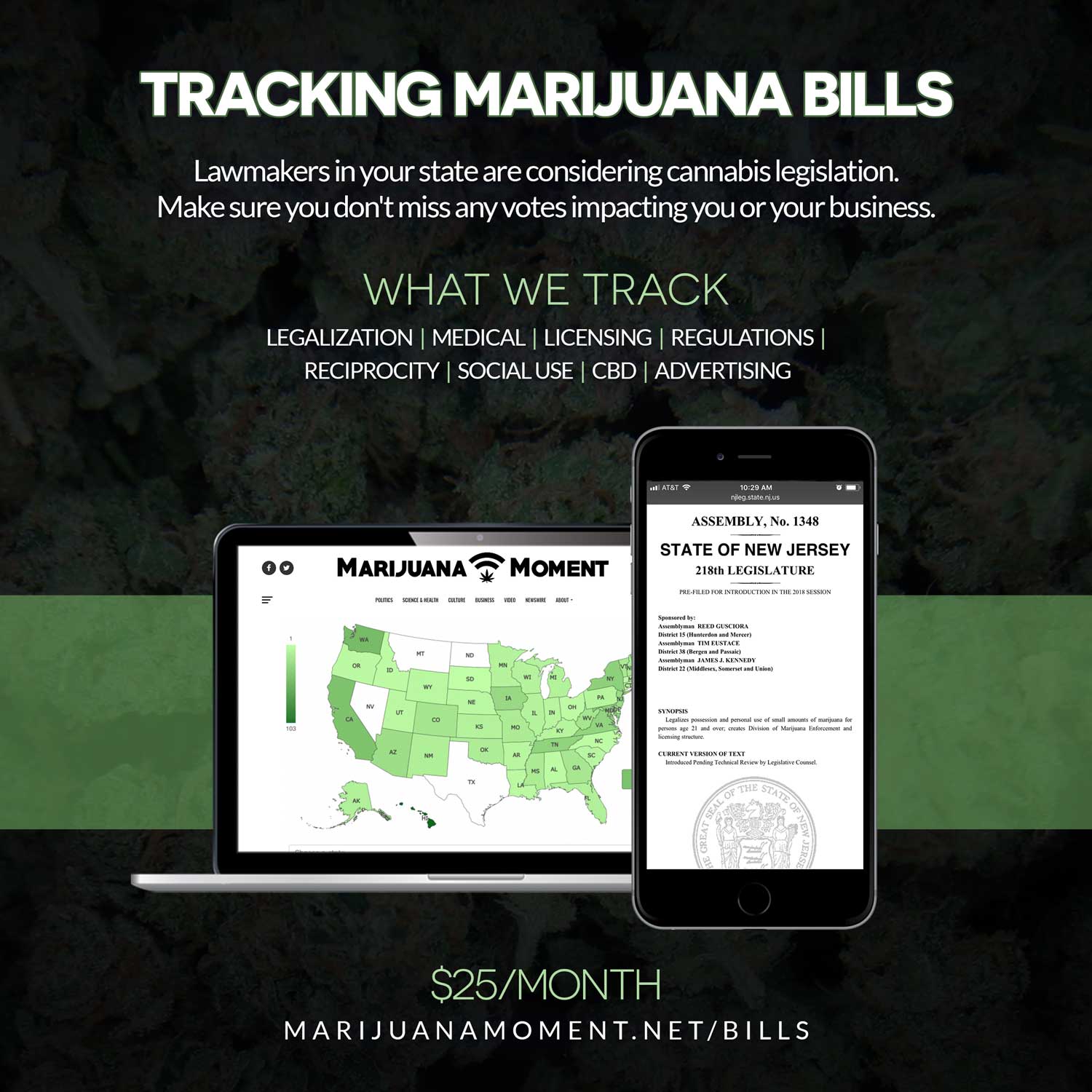
Learn more about our marijuana bill tracking and become a Patreon supporter to gain access
—
The US Department of Agriculture published this month shows that US farmers grow $3 billion in hemp crops by 2025— 64% increase compared to the previous year.
Meanwhile, this month the Trump administration launched a new initiative Cover up to $500 of hemp-derived products annually for eligible Medicare patients. The program being implemented by the Centers for Medicare and Medicaid Services (CMS) focuses largely on CBD, but also allows a certain amount of THC in products.
Anti-marijuana organizations filed a lawsuit against the Medicare hemp coverage policyand Health and Human Services attorneys. Robert F. Kennedy Jr. and CMS Director Mehmet Oz recently He submitted a letter requesting the filing of the case.
Meanwhile, the White House Management and Budget Office has held a series of meetings a Food and Drug Administration (FDA) CBD product enforcement policy.
The FDA also issued guidance making it clear that it does not intend to interfere Establish a Medicare coverage plan for hemp-derived products.
CMS finalized a rule that will be adopted separately Coverage of certain hemp products, primarily as specialized health-related benefits, through Medicare Advantage the plans
As hemp products become more popular among consumers, some big brands are trying to get in on the action.
The main retailer Target, for example, is expanding its involvement in the hemp-derived THC beverage market. Last year, the company began a pilot program in 10 stores in Minnesota that sell cannabis drinks. That apparently went well, and now the company has secured licenses from Minnesota regulators to sell lower-potency edible hemp products — including THC drinks — in 72 stores in the state.
Marijuana Moment is made possible with the help of readers. If you rely on our pro-cannabis journalism to stay informed, consider a monthly Patreon pledge.
North Carolina lawmakers say they’re fueling debate over the state’s marijuana laws — a move by the Trump administration to reclassify it as a less dangerous drug.
Across the country, a set of laws and enforcements regulate marijuana. The drug is illegal under federal law, but dozens of US states have legalized it. And almost all states have legalized medical marijuana prescriptions for certain ailments. North Carolina is among the remaining states to resist any form of legalization. Republican politicians in North Carolina have resisted passing any bills to legalize or decriminalize marijuana, despite public opinion polls showing broad public support for such changes.
Senate President Phil Berger said he expects his chamber to revisit efforts to legalize medical marijuana this week. “We will have a conversation within our caucus if they are interested in whether we do something,” Berger told reporters Tuesday.
The recent actions of Republican President Donald Trump may add a new dimension to these conversations. Trump’s acting attorney general on Thursday signed the drug classification as a less dangerous and less strictly regulated drug than marijuana. Federal law does not legalize marijuana for medical or recreational use.
Read more at WRAL News

The Biggest Things About Schedule III You Haven’t Thought Of

Klasmann-Deilmann announces management changes

Congressional Amendments To Delay Or Speed Up Federal Hemp THC Product Ban Won’t Get Votes

Missouri Gov. Signs Bill to Align State Hemp Rules with Federal Changes

Remo Nutrients is NOW in Mexico!

Cannabis Coast to Coast News with Alaina Pinto; Canada, Arizona, Nevada, New Jersey state reports

🌱First 2 Weeks Of Veg: Don’t Make THESE Mistakes

AUTISM & CANNABIS | THE ZARTLER FAMILY

NC lawmakers revisit marijuana policy following reclassification

Indiana GOP Governor Directs State Agencies To Meet With Medical Marijuana Advocates As Federal Rescheduling Takes Effect

“Our system can manage equipment across 10,000+ m² using just a few wires”

Florida Workshop to Discuss What Constitutes a ‘Cartoon’ in Hemp Packaging

Mazar-i-Sharif Hash Wednesday

Re-release of the full show of Cannabis Coast to Coast news. Republican Texas DA Fires Up vs. laws;

From Finance to Wellness: Brad Zerman’s Impactful Pivot

Weak Michigan Cannabis Sales Again in July – New Cannabis Ventures

DEA’s Cole Reverses His “priorities” ; Prohibitionists Dig In; Dead & Co Celebrates 60 years in SF

Your Cannabis Business: Consistent Filings Are Critical

Afghan Black Hash Wednesday

Curaleaf Q2 Revenue Falls 8% – New Cannabis Ventures
-
 Cannabis News8 months ago
“Our system can manage equipment across 10,000+ m² using just a few wires”
-
 Florida8 months ago
Florida Workshop to Discuss What Constitutes a ‘Cartoon’ in Hemp Packaging
-
 Video7 months ago
Mazar-i-Sharif Hash Wednesday
-
 Video9 months ago
Re-release of the full show of Cannabis Coast to Coast news. Republican Texas DA Fires Up vs. laws;
-
 Video9 months ago
From Finance to Wellness: Brad Zerman’s Impactful Pivot
-
 aawh9 months ago
Weak Michigan Cannabis Sales Again in July – New Cannabis Ventures
-
 Video8 months ago
DEA’s Cole Reverses His “priorities” ; Prohibitionists Dig In; Dead & Co Celebrates 60 years in SF
-
 Best Practices8 months ago
Your Cannabis Business: Consistent Filings Are Critical