
Cannabis News
Labor management system even more widely applicable after update

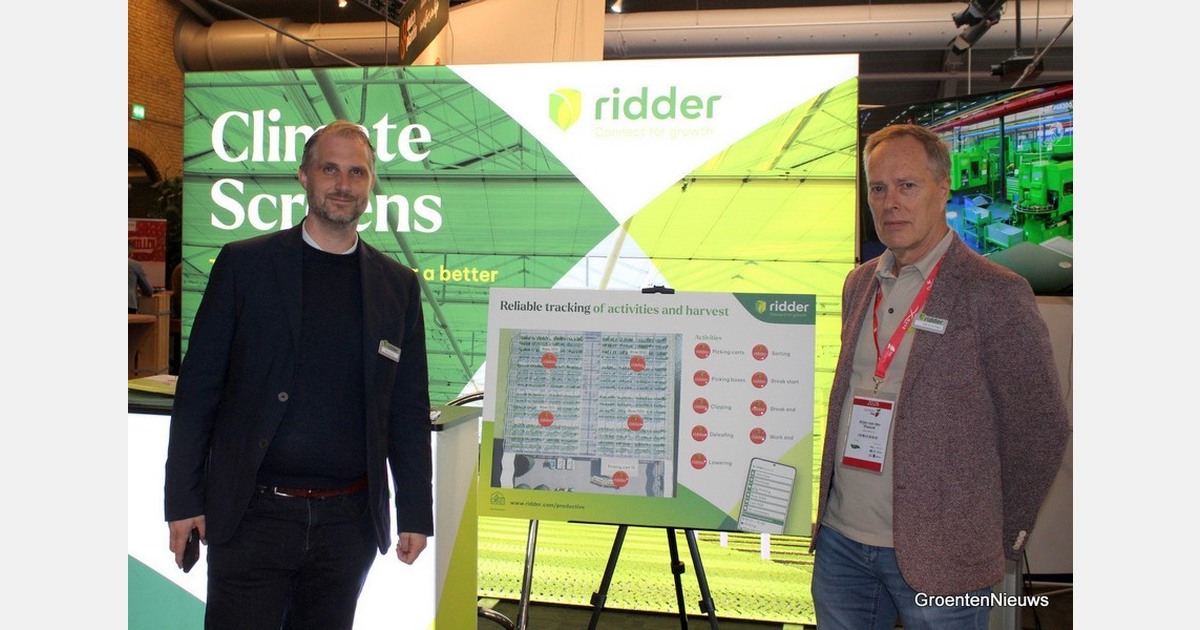
In the Netherlands, greenhouse growers are increasingly looking for ways to manage energy and labor costs. This was also a key theme at the recent Aardbeiendag (Strawberry Day), where Ridder presented its work management system, Ridder Productive. The system has been updated to better meet the specific needs of strawberry growers, with further updates being developed. Sales director Niels Hiemstra explained.
Ridder Productive has been on the market for over 30 years and is widely used in the greenhouse industry. According to Hiemstra, the system has traditionally been adopted by large fruit and vegetable producers. “As Ridder, we focus on those growers in the Netherlands, Belgium and North America and Mexico as well. However, the product itself is fundamentally much broader.”
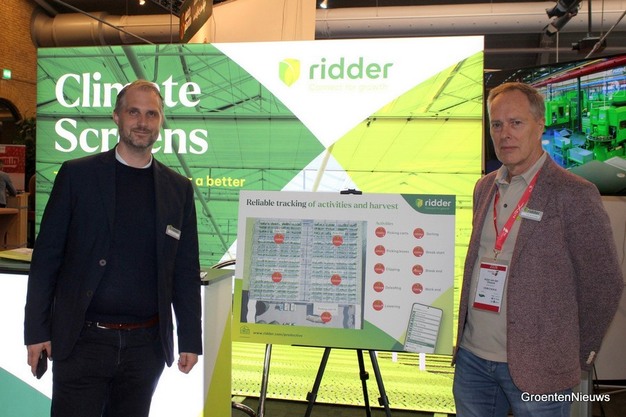 © Thijmen Tiersma | MMJDaily.comNiels Hiemstra and Arjan van der Klaauw on Strawberry Day
Adapted for strawberry cultivation
The work management system allows growers to record what tasks are done, where and when they are done and what the production is. At the request of customers, specific adjustments have been made for strawberry production, so that labor and production can be recorded more precisely.
In the early years, before the change to Ridder Productive, the system was known as P-Plus or PadPlus. It supported a work record per row. Strawberry growers, however, harvest the crop in crates that are placed in crates. Therefore, Ridder has introduced the possibility to record the activities of each box containing packaged fruit.
NFC tags or QR codes
The system uses scanners capable of reading NFC tags and QR codes. As Hiemstra explains: “In a previous version of the system, which is still widely used, growers work with fixed terminals in various places in the greenhouse. Work activities are recorded by entering the corresponding codes. This can lead to errors. When an NFC tag is reduced in a row, on a harvest trolley or in a box or box in strawberry production, it mainly reduces errors by the user. Terminal-based registration in scanners with NFC tags.”
The option to scan QR codes or barcodes also creates opportunities for traceability. QR codes could already be scanned for punnets, and this functionality has now been extended to other elements, such as rows. A QR code or barcode from an external party can also be used, allowing the scanned product to be tracked to the customer throughout the supply chain. This allows growers to see where, when and by whom a specific crate or crate was harvested.
With these adaptations, Ridder Productive has become more suitable for strawberry cultivation, which is increasingly carried out in high-tech greenhouses. As a result, cultivation has come closer to Ridder’s traditional approach. Hiemstra occasionally knows strawberry growers who don’t use labor record systems, but who are considering it as their business expands. “As they grow, they realize that more professionalization is necessary. They move from basic time recording to a more detailed and comprehensive work management system.”
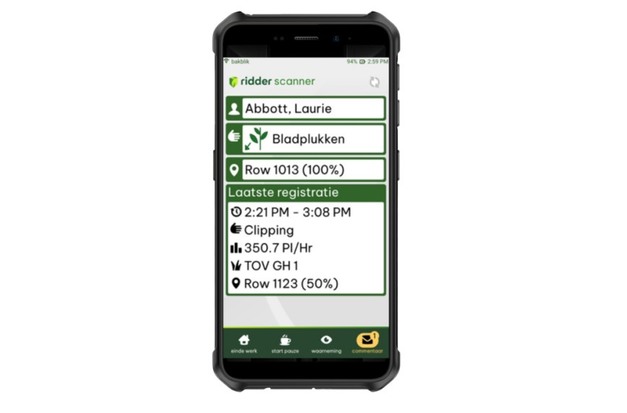 © RidderWith the Scanner app, an employee scans NFC tags or QR codes
Combining greenhouse and outdoor cultivation
In the Netherlands, Ridder has traditionally been active in high-tech greenhouses. However, Ridder Productive can also be used in open ground production, for example by strawberry growers who combine greenhouse cultivation with outdoor fields. In both situations, a detailed and accurate work record is required.
“Measuring who does what and where can be done both in the greenhouse and in field crops,” says Niels Hiemstra. “Instead of linking data to a specific row in the greenhouse, you can just as easily link it to a specific area.”
He recognizes that the labor management system is still relatively little used in outdoor cultivation. However, he hopes that may change as strawberry production continues to expand. Lettuce and herb producers, for example, combine greenhouse and outdoor production.
Outside the Netherlands, Hiemstra knows users of Ridder Productive in lettuce production. The ability to scan NFC tags or QR codes plays an important role. “When we only worked with fixed terminals, it was less practical to use in open areas, partly because of the cable requirements. Hardware was a limitation. Now that we work with scanners and can equip robust smartphones for scanning, the system has become more accessible for outdoor crops.”
In principle, ornamental producers can also use the system. However, Hiemstra points out that there is generally less demand for detailed employment records in this segment. “Often, more attention is paid to the entire production. But for companies that want to accurately measure work performance, the system can certainly be applied there as well.”
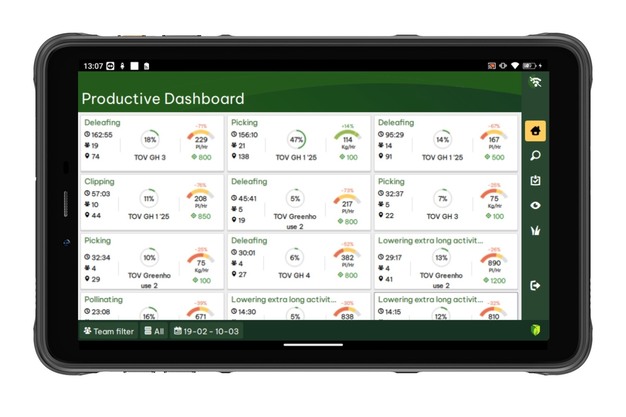 © RidderRidder also offers a manager application in Ridder Productive. There, a work manager can see the performance of the employees.
New version coming soon
Ridder Productive, which has been in the market for more than three decades, continues to evolve. According to Niels Hiemstra, continuous development is essential, especially in software. “If you get stuck in software, you quickly fall behind.”
The ’26 version is expected to be introduced this year. “It includes many small improvements that make everyday use easier. They may not all be very visible, but they make a difference in practice.”
This is on purpose, he explained. Satisfied users aren’t necessarily looking for major changes every six to twelve months. They prefer stability in features that work well and are popular. Ridder takes this into account in the upcoming update.
One area where the changes will be more noticeable is the dashboard environment. In cooperation with various manufacturers, the design and information display have been significantly improved. “We offer a standard configuration, but it is possible to create a custom panel at the request of the user with the help of our service department.”
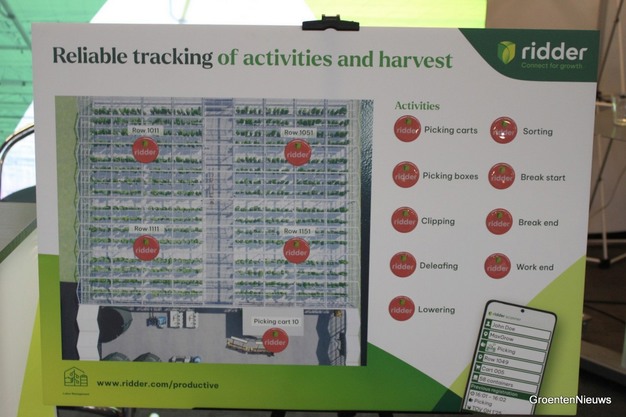 © Thijmen Tiersma | MMJDaily.com
Combining with other data sources
In addition to work management systems, many greenhouse companies know Ridder for their drive systems, Hortimax climate computers and climate monitors.
In terms of software, Ridder deliberately keeps the Ridder Productive and the Hortimax climate computer as separate systems. “Both products are part of the management of a modern greenhouse operation,” says Niels Hiemstra, “but growers can choose from us whether they want to use both systems.”
Growers who work with a different climate computer can also use Ridder Productive. According to Hiemstra, Ridder is open to creating data links with other systems upon user request. “This way, we ensure that our systems fit into the wider greenhouse ecosystem and that the grower is properly protected.”
For more information:
Niels Hiemstra
Equestrian
(email protected)
www.ridder.com/nl/arbeidsmanagement












cbdMD welcomes the Administration’s call for Congress to ensure fair treatment of hemp-derived products under federal law and calls for immediate action to revise hemp regulations to ensure fair treatment of hemp products under federal law.
In a letter to congressional leadership this week, the White House Office of Management and Budget identified hemp reform as a priority strongly supported by the Administration. The petition calls on Congress to ensure fair treatment of hemp-derived products by maintaining access to appropriate full-spectrum CBD products, and by maintaining Congress’ intent to reduce products that pose health risks. The administration also urged Congress to pass a responsible federal framework or at least extend the current implementation period to give lawmakers time to get policy right. The request builds on the president’s previous public statements urging lawmakers to protect access to full-spectrum CBD products that millions of Americans rely on.
“We are encouraged to see the administration so clearly championing the responsible, scientific hemp products that consumers depend on every day,” said Ronan Kennedy, CEO of cbdMD. “cbdMD has always believed that the future of this category is built on quality, transparency, and clear rules that separate them from bad actors. A federal framework that protects consumer access, promotes safety, and provides certainty to companies that provide certainty is what this industry and the people it serves deserve. We applaud the policymakers who are working to achieve this outcome.”
“We believe CbdMD is purpose-built for this next phase of the market,” added Kennedy. “Our focus remains on serving our customers with reliable and effective products, supporting responsible regulation and building long-term value for our shareholders as the category continues to evolve. Along the way, we will continue to evaluate the opportunities this evolving environment holds.”
For more information:
cbdMD 
cbdmd.com/
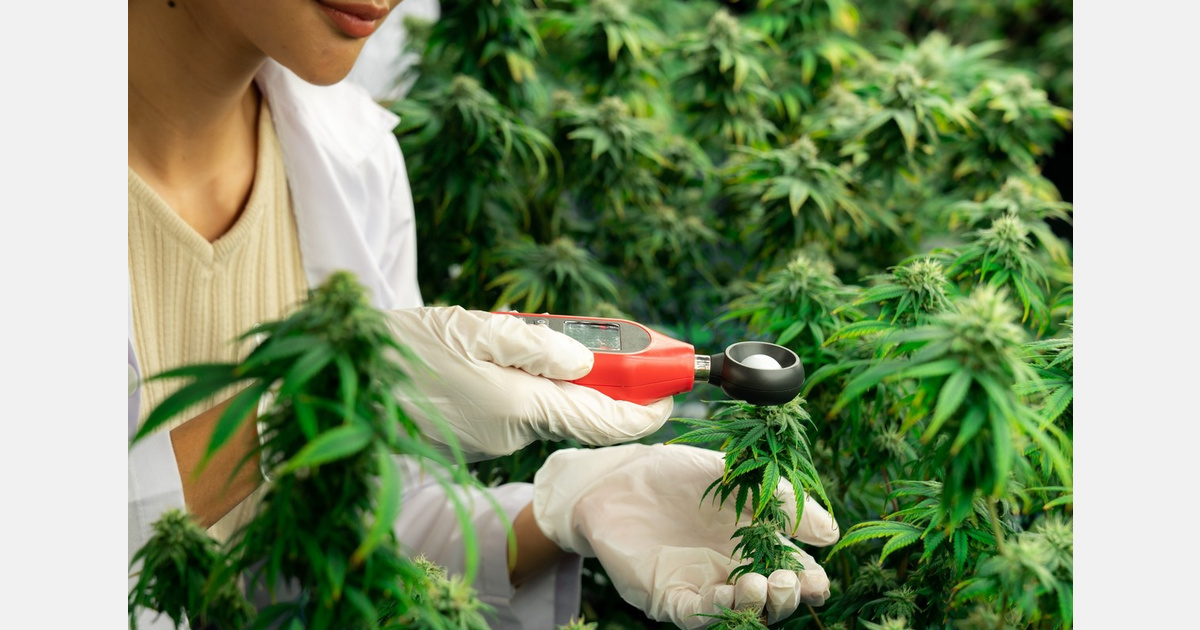
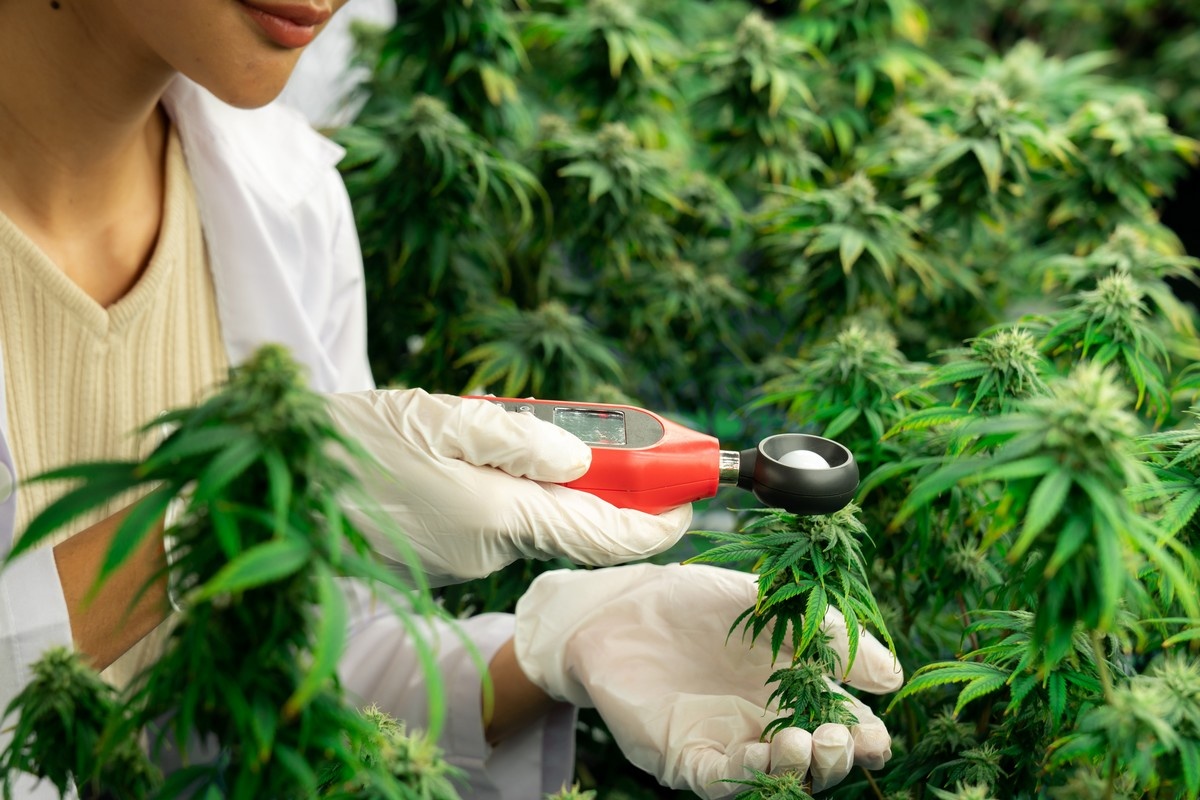
Two new RAND reports commissioned by the Richard M. Fairbanks Foundation outline the policy options and financial commitments facing Indiana as the state debates whether to change its cannabis laws amid restrictions across the country.
Reports show that 44% of Indiana residents live within 50 miles of a licensed dispensary in a neighboring state, and 96% live within 100 miles, as three of Indiana’s four states have legalized adult-use cannabis. At the same time, intoxicating hemp products containing the same psychoactive compound as marijuana are available at gas stations, convenience stores and grocery stores throughout Indiana with limited oversight.
Cannabis use in Indiana has doubled in the past decade, with a significant increase among adults 26 and older. RAND estimates that 1.3 million Hoosiers used cannabis in 2024 and spent $1.8 billion on marijuana products that year. Indiana recorded more than 13,000 cannabis-related arrests in 2024, with more than 90% for possession and more than 75% for non-cannabis related charges. The state spends $10 million to $20 million annually on cannabis law enforcement.
Rather than recommending a specific policy, the RAND reports outline four broad options: maintaining prohibition, reducing criminal penalties for possession, legalizing medical cannabis, or legalizing the adult recreational use market. Legalizing adult-use cannabis would generate about $180 million in annual state revenue, roughly 1 percent of the state’s general fund, well below some previous projections and less than half of the $385 million in combined cigarette and alcohol tax revenue Indiana will collect in 2025, according to the Indiana Department of Revenue.
Legalization would also entail significant upfront costs, and ongoing regulatory costs could reach the low tens of millions of dollars annually, outweighing the savings from reduced criminal justice spending. RAND identifies 14 policy considerations important to establishing legal markets, each with its own public health and state economic implications.

Weed Talk News Special Report & Interview Redefining Hemp Throws Industry into Turmoil

INVESTING IN CANNABIS | EMILY PAXHIA

cbdMD welcomes White House call for fair treatment of hemp-derived products

Industry Sentiment vs Reality – Could The Hemp Ban Be Extended?

Applications For Missouri Marijuana Microbusiness Licenses Will Open Next Month

Half of Gen Z Diagnosed with Depression Report Using Cannabis

Will the Farm Bill of 2024 Close Down Hemp Derived Highs? The Full A and B Blocks of Weed Talk News

Let’s Be Blunt with Montel – Algorithmic Boost Request – 2000000 #YTBoostRequest

RAND estimates Indiana adult-use cannabis could yield $180M in annual revenue

Institutions Evaluate Cannabis While Trulieve CEO Sells Shares

“Our system can manage equipment across 10,000+ m² using just a few wires”

Florida Workshop to Discuss What Constitutes a ‘Cartoon’ in Hemp Packaging

Mazar-i-Sharif Hash Wednesday

Afghan Black Hash Wednesday

Weak Michigan Cannabis Sales Again in July – New Cannabis Ventures

From Finance to Wellness: Brad Zerman’s Impactful Pivot

DEA’s Cole Reverses His “priorities” ; Prohibitionists Dig In; Dead & Co Celebrates 60 years in SF

Re-release of the full show of Cannabis Coast to Coast news. Republican Texas DA Fires Up vs. laws;

Curaleaf Q2 Revenue Falls 8% – New Cannabis Ventures

Your Cannabis Business: Consistent Filings Are Critical
-
 Cannabis News10 months ago
“Our system can manage equipment across 10,000+ m² using just a few wires”
-
 Florida11 months ago
Florida Workshop to Discuss What Constitutes a ‘Cartoon’ in Hemp Packaging
-
 Video9 months ago
Mazar-i-Sharif Hash Wednesday
-
 Video9 months ago
Afghan Black Hash Wednesday
-
 aawh11 months ago
Weak Michigan Cannabis Sales Again in July – New Cannabis Ventures
-
 Video11 months ago
From Finance to Wellness: Brad Zerman’s Impactful Pivot
-
 Video10 months ago
DEA’s Cole Reverses His “priorities” ; Prohibitionists Dig In; Dead & Co Celebrates 60 years in SF
-
 Video11 months ago
Re-release of the full show of Cannabis Coast to Coast news. Republican Texas DA Fires Up vs. laws;