
Cannabis News
Virginia Hemp Businesses Consider How To Pivot With Federal Ban Looming



Cannabis News
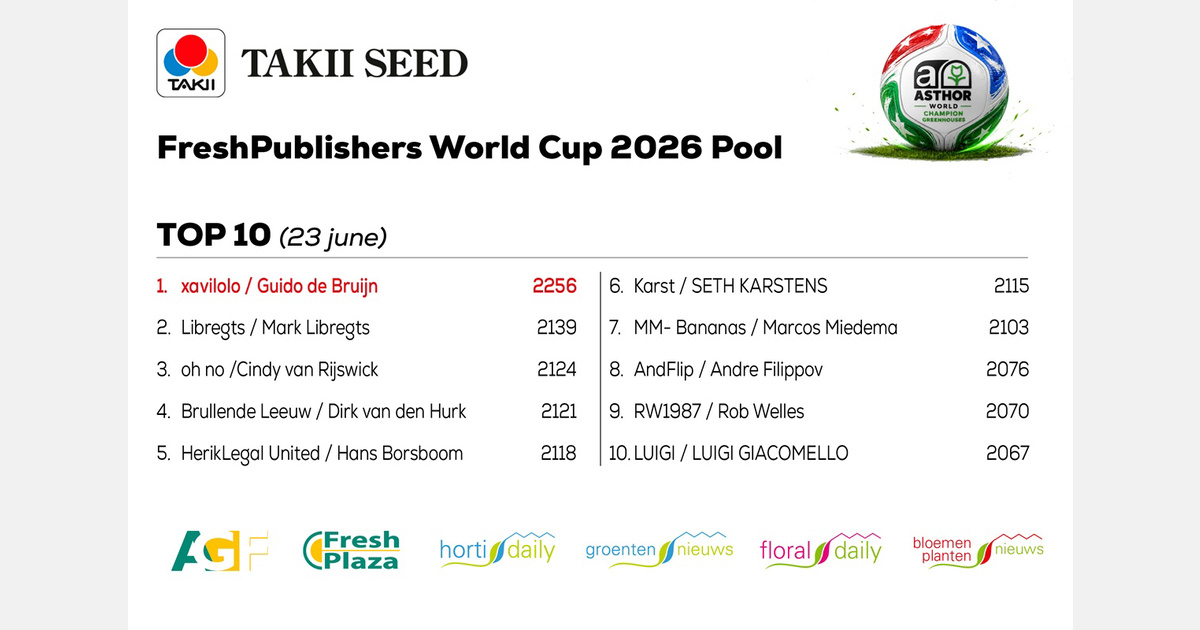
Guido de Buijn (Agrofair) consolidates his leading position, whilst fruit and vegetable lawyer Hans Borsboom enters the top five
FreshPublishers 2026 World Cup Group Stage
Today, it is the Dutch who are making their mark in the Fresh Publishers’ World Cup rankings. Guido de Bruijn, Agrofair’s account manager, correctly predicted the results of the Argentina – Austria and France – Iraq matches, thus consolidating his leadership. He is followed by quality controller Mark Libregts of JNV Produce, while food and agriculture specialist Cindy van Rijswick of Rabobank has once again rounded out the top three. In fourth place is Dirk van den Hurk, aaff’s relationship manager. He has a three-point lead over fruit and vegetable lawyer Hans Borsboom, who is competing under the name HerikLegal United. Interestingly, the main contestants predict very different winners. Guido supports Portugal, Mark supports France, Cindy supports Germany and Dirk and Hans support Spain.
In sixth place is Seth Karstens, who manages retail sales for Gerbera United. Marcos Miedema – again from Agrofair – is seventh, ahead of Andre Filippov from the German company Global Fruit Point. Rob Welles of plant grower Ovata and Italian potato and vegetable trader Luigi Giacomello have slipped a little further up the table and are in ninth and tenth place. However, there is still a long way to go to win the 1,000 euros. Starting with the next four matches: Portugal – Uzbekistan, England – Ghana, Panama – Croatia and Colombia – Congo.
 © FreshPublishers
Cannabis News
Marijuana Moment Asks DEA Judge To Allow Livestreaming Of Rescheduling Hearing For Transparent Public Access
Cannabis News
Judge declines to block New Jersey cannabis Labor Peace Agreement requirement in Curaleaf case


U.S. District Judge Michael A. Shipp, for the District of New Jersey, ruled against Curaleaf Holdings Inc.’s request for emergency relief to block the requirement that New Jersey cannabis companies sign Labor Peace Agreements (LPAs) to keep the rule in place while the underlying case continues.
Under Bloomberg Law, Judge Shipp issued an unpublished opinion that Curaleaf failed to demonstrate the “irreparable harm” courts require before issuing a preliminary injunction. That rule requires a party to prove that it will later suffer irreparable injury if the judge waits for full proceedings. Judge Shipp concluded that Curaleaf did not meet that threshold.
The resolution is not a decision on the substance of the regulation. Judge Shipp expressed skepticism that the LPA’s requirement is supported under federal law, although he declined to block it. A court may find that a challenger has failed to meet the standard of emergency assistance without adopting the challenged rule.
The New Jersey Cannabis Regulatory Enforcement Assistance and Market Modernization Act, known as CREAMMA, was signed into law by then-governor Phil Murphy in February 2021. It set up a 2020 legalization referendum and established the state’s adult cannabis market. Under CREAMMA, cannabis operators must sign an LPA and engage in collective bargaining with organized labour. These are two different obligations, both licensing requirements, not optional practices.
Curaleaf is opposing this dual mechanism. For New Jersey cannabis operators, the immediate consequence is that compliance remains mandatory while the case moves forward. The question of whether the LPA’s mandate is compatible with federal law remains unanswered.
Source: HeadyNJ

Schedule 3? Farm Bill 2024? Those are the Talk Topics for a Weed Talk News Special Report Talk Show

CANNABIS TALK | SECOND LADY OF PA GISELE FETTERMAN

Marijuana Retail Report

Guido de Buijn (Agrofair) consolidates his leading position, whilst fruit and vegetable lawyer Hans Borsboom enters the top five

The Most Important Hearing In Cannabis History

Marijuana Moment Asks DEA Judge To Allow Livestreaming Of Rescheduling Hearing For Transparent Public Access

New York Lawmakers Pass Bill to Prevent Inversion of Illicit Cannabis into Legal Market

Is it time to Legalize? Tell Your Cannabis Story to the DEA! Public Comment time for rescheduling!

LAGANJA ESTRANJA TALKS CANNABIS

Marijuana Retail Report

“Our system can manage equipment across 10,000+ m² using just a few wires”

Florida Workshop to Discuss What Constitutes a ‘Cartoon’ in Hemp Packaging

Mazar-i-Sharif Hash Wednesday

Afghan Black Hash Wednesday

Weak Michigan Cannabis Sales Again in July – New Cannabis Ventures

From Finance to Wellness: Brad Zerman’s Impactful Pivot

DEA’s Cole Reverses His “priorities” ; Prohibitionists Dig In; Dead & Co Celebrates 60 years in SF

Re-release of the full show of Cannabis Coast to Coast news. Republican Texas DA Fires Up vs. laws;

Your Cannabis Business: Consistent Filings Are Critical

Curaleaf Q2 Revenue Falls 8% – New Cannabis Ventures
-
 Cannabis News10 months ago
“Our system can manage equipment across 10,000+ m² using just a few wires”
-
 Florida10 months ago
Florida Workshop to Discuss What Constitutes a ‘Cartoon’ in Hemp Packaging
-
 Video9 months ago
Mazar-i-Sharif Hash Wednesday
-
 Video9 months ago
Afghan Black Hash Wednesday
-
 aawh10 months ago
Weak Michigan Cannabis Sales Again in July – New Cannabis Ventures
-
 Video10 months ago
From Finance to Wellness: Brad Zerman’s Impactful Pivot
-
 Video10 months ago
DEA’s Cole Reverses His “priorities” ; Prohibitionists Dig In; Dead & Co Celebrates 60 years in SF
-
 Video10 months ago
Re-release of the full show of Cannabis Coast to Coast news. Republican Texas DA Fires Up vs. laws;