



Tilray Brands Delivers Record Q2 FY2026 Net Income of $218 Million, Moves to Net Cash Position and Reaffirms Full-Year Adjusted EBITDA Guidance.
International Medical Cannabis Revenue Increases 36%; Cannabis income by Canadian adults increased by 6%
Tilray Pharma achieves record quarterly revenue
US Federal Cannabis Reregulation Expected to Open New Market Opportunity for Tilray’s Medical Expansion in the US
Strong financial position with $292 million in cash and marketable securities¹ and ~$30 million in net cash
NEW YORK and LONDON and LEAMINGTON, Ontario, Jan. 08, 2026 (GLOBE NEWSWIRE) — Tilray Brands, Inc. (“Tilray,” “our,” “we” or the “Company”) (Nasdaq: TLRY; TSX: TLRY), a global lifestyle and consumer packaged goods company, a leader in the cannabis, beverage and health industries, today reported financial results for its second fiscal quarter ended November 30, 2025.
Irwin D. Simon, Chairman and Chief Executive Officer, commented: “We delivered another record quarter with net revenue of $218 million driven by orderly execution across our diversified portfolio spanning the cannabis, beverage, health and distribution industries. Our business model supports our scalability, market value creation, adaptability as well as long-term performance. Strengthening our core operations The quarter ended with a strong balance sheet and strong liquidity, underscoring our prudent financial management and giving us the flexibility to make selective investments in strategic growth initiatives.
Mr. Simon continued. “We believe federal realignment will mark an important step forward for medical cannabis in the United States, paving the way for more research, broader physician involvement, and better patient access. Tilray has invested over the years in developing the infrastructure, expertise and discipline necessary to operate successfully in the highly regulated medical markets. With a key role in building a responsible, research-oriented national medical cannabis industry with the team and platform already in place with Tilray Medical US, we intend to leverage the infrastructure, expertise and knowledge developed with Tilray Medical’s expected $150 million medical cannabis business and our new $300 million Tilray Pharma medical distribution platform. trials and partnerships for product development”.
_________________________ ¹Cash and marketable securities and net (borrowed) cash are non-GAAP financial measures. See “Use of Non-GAAP Measures” below for further discussion of these non-GAAP measures and a reconciliation of this non-GAAP measure to our most comparable GAAP measure.
Financial milestones All comparisons with the previous year period
Net income rose 3% in the second quarter to $217.5 million from $211.0 million.
Gross profit in the second quarter was 57.5 million dollars, against 61.2 million dollars.
Gross margin was 26% in the second quarter, up from 29%.
Cannabis net revenue increased 3% to $67.5 million in the second quarter, compared to $65.7 million, driven by 36% growth in international cannabis and 6% growth in Canadian adult cannabis, offset by a lower presence of Canadian bulk cannabis in anticipation of deployment in international markets.
Cannabis’ gross profit rose to $26.1 million in the second quarter, up from $23.2 million.
In the second quarter, hemp gross margin increased to 39% from 35%.
Beverage net revenue in the second quarter was $50.1 million, compared to $63.1 million.
Beverages gross profit in the second quarter was $15.7 million, compared to $25.2 million.
Beverages gross margin was 31% in the second quarter, up from 40%.
Wellness net income was flat at $14.6 million in the second quarter.
Wellness’s gross profit rose to $4.6 million in the second quarter from $4.5 million.
Health’s gross margin increased to 32% from 31% in the second quarter.
Net distribution income, which includes Tilray Pharma, increased to our highest revenue quarter ever to $85.3 million in the second quarter, up from $67.6 million in the second quarter.
The distribution’s gross profit increased to $11.0 million in the second quarter, compared to $8.4 million.
In the second quarter, gross distribution margin increased to 13% from 12%.
Second-quarter net loss improved to $43.5 million from $41.8 million, compared to a net loss of $85.3 million, and second-quarter net loss per share improved to $0 ($0.41) from $0.99.
Adjusted net loss² and adjusted net loss per share2 improved to $(2.0) million and $(0.02) in the second quarter, compared to $(0.02) and adjusted net loss of $(2.2) million and $(0.03). Excluding non-cash income tax charges, adjusted net income and adjusted net income per share would have been $1.6 million and $0.01.
Adjusted EBITDA³ was $8.4 million in the second quarter, compared to $9.0 million.
Cash flows. Cash used in operations improved from $32.2 million to $8.5 million from $40.7 million.
Balance update. In the second quarter, we increased our cash and marketable securities balance to $291.6 million, providing flexibility for strategic opportunities. In addition, we reduced our total outstanding debt by $4.2 million, further strengthening the balance sheet.
Net (debit) Cash position. Our Q1 net debt position of $3.8 million improved sequentially by $31.2 million to a total net cash position of $27.4 million.
Adjusted EBITDA guidance for fiscal 2026 restated to $62 million – $72 million
New Cannabis Ventures’ NCV Newswire aims to gather high-quality content and information about leading cannabis companies to help our readers filter through the noise and stay on top of the most important cannabis business news. The NCV Newswire is edited by an editor and is not, however, automated. Got a secret news tip? Get in touch.
You are reading this week’s edition of New Cannabis Ventures, a weekly magazine we have published since October 2015. The newsletter includes unique insight to help our readers stay ahead of the curve, as well as links to the most important news of the week. We no longer email them like we used to, but post this and all newsletters on our website here.
friends,
Earnings season kicked off this week, and so far it’s been a mixed bag. Green Thumb Industries beat expectations, while Trulieve missed. Cronos Group also missed adjusted EBITDA despite falling revenue.
What’s most interesting to me about these quarterly reports are the updates we get in documents or press releases. A large category is share buybacks that are done.
GTI, which has a strong balance sheet, especially compared to other MSOs, has bought back more inventory. Cronos Group, which is cash- and debt-free, also bought some shares in November and December. These shares were acquired at close to tangible book value.
Trulieve did not report the share buyback, but the 10-K disclosed a 2025 bonus announced on 2/24 for CEO Rivers. The company has net cash, but its tangible book value is very negative and has deteriorated. The company does not buy back shares.
Ascend is set to report Q4 financials on 3/12 and it will be interesting to see if this very cheap stock company continues to buy back shares. The company has negative tangible book value, and the GTI 10-K disclosed that Ascend paid a $17 million penalty to GTI on 2/12, so I don’t expect it to be as aggressive with buybacks.
Stock buybacks seem like a good thing, especially when valuations are so low. However, investors should be wary of hemp companies buying back shares when they have balance sheet challenges.
Sincerely,
Alan:
New Cannabis Ventures publishes curated articles as well as exclusive news. Here is what we have published in the last 2 weeks.
Follow Alan for real-time updates X.com:. Share and discover industry news with like-minded people on the largest group of cannabis investors and entrepreneurs LinkedIn:.
Stay on top of the most important communications from public companies by watching what’s coming cannabis investor calendar.
Based in Houston, Alan leverages his experience as an online community founder 420 Investorthe first and still the largest due diligence platform focused on publicly traded stocks in the cannabis industry. With his extensive network in the cannabis community, Alan continues to find new ways to connect the industry and facilitate its sustainable growth. time New Cannabis Ventureshe is responsible for content development and strategic alliances. Before turning his attention to the cannabis industry in early 2013, Alan, who began his career on Wall Street in 1986, worked as an independent research analyst with more than two decades of research and portfolio management experience. A prolific writer, with over 650 articles published since 2007 Looking for Alphawhere he has 70,000 followers, Alan is a frequent speaker at industry conferences and frequent source Media including the NY Times, Wall Street Journal, Fox Business and Bloomberg TV. Contact Alan. Twitter: |: Facebook |: LinkedIn: |: El

Hemp stocks, as measured by the Global Hemp Stock Index, were quite volatile in 2024 and then again in 2025 as well. Although the index rose in December, it fell on the year. In January, the indicator decreased by 10.6%, reaching 5.89. February saw a drop in prices, but the market recovered with the index ending the month at 5.86, down 0.5%.
After collapsing 21.8% in late 2024 to 6.88 in Q4, the index fell heavily in Q1 and then marginally in Q2. The global hemp stock index, which now has 27 members, gained 53.0% in the third quarter but fell 14.2% in the fourth quarter, down 4.2% for the full year. In 2026, it decreased by 11.1%.
Since its peak in February 2021, the global hemp stock index is down 93.7% from a closing high of 92.48.
The 3 strongest names in February, each an MSO, were all up more than 13%;
Jazz Pharma rallied in 2026, but the other two declined.
February’s 3 weakest names are all down more than 13%;
All three have fallen significantly in 2026 so far.
We will summarize the performance of the index again in a month. In April, we historically combined the two articles, and we update here the other indexes that New Cannabis Ventures continues to maintain: the American Cannabis Operator Index, the Ancillary Cannabis Index, and the Canadian Cannabis LP Index.
American Hemp Operator Index
The ACOI sank in January, falling 12.5% to 11.53, and fell further in February, falling 5.8% to 10.87. In 2025, it increased by 57.7% to 13.18 and decreased by 17.5% in 2026. The large AdvisorShares Pure US Cannabis ETF ( MSOS ) fell 3.7% in February.
The strongest performing stock in February was TerrAscend (OTC: TSNDF ), up 7.7%. The weakest, Vireo Growth (OTC: VREOF ), fell 17.9%.
In March, the index will have seven members with the removals of Jushi Holdings (OTC: JUSHF ) and Vireo Growth.
Auxiliary cannabis index
Ancillary commodities lost 5.7% in February as the index fell to 9.84. The index decreased by 19.5% in 2025, reaching 11.09, and this year it decreased by 11.3%.
The strongest stock in February was Turning Point Brands (NASDAQ: TPB ), which rose 13.1%. The weakest iPower fell by 55.8%.
In March, the index will have seven members after the removal of GrowGeneration (NASDAQ: GRWG ), iPower (NASDAQ: IPW ) and Chicago Atlantic BDC (NASDAQ: LIEN ) during February’s low trading volume.
Canadian Hemp LP Index
Canadian LPs fell 0.9% in February as the index fell to 55.65. In 2025, the index increased by 17.8%, reaching 59.01, and in 2026, it decreased by 5.7%.
The strongest Canadian LP in February was Rubicon Organics (TSXV: ROMJ ), which rose 8.9%. Simply Insoluble Concentrates (TSXV: HASH ) was the weakest, down 27.8%.
In March, the index will have the same thirteen members.
Based in Houston, Alan leverages his experience as an online community founder 420 Investorthe first and still the largest due diligence platform focused on publicly traded stocks in the cannabis industry. With his extensive network in the cannabis community, Alan continues to find new ways to connect the industry and facilitate its sustainable growth. time New Cannabis Ventureshe is responsible for content development and strategic alliances. Before turning his attention to the cannabis industry in early 2013, Alan, who began his career on Wall Street in 1986, worked as an independent research analyst with more than two decades of research and portfolio management experience. A prolific writer, with over 650 articles published since 2007 Looking for Alphawhere he has 70,000 followers, Alan is a frequent speaker at industry conferences and frequent source Media including the NY Times, Wall Street Journal, Fox Business and Bloomberg TV. Contact Alan. Twitter: |: Facebook |: LinkedIn: |: El
You are reading this week’s edition of New Cannabis Ventures, a weekly magazine we have published since October 2015. The newsletter includes unique insight to help our readers stay ahead of the curve, as well as links to the most important news of the week. We no longer email them like we used to, but post this and all newsletters on our website here.
friends,
While the US is getting a lot of attention from cannabis investors, the industry faces many challenges in America. It’s been more than 12 years since Colorado shops opened their doors to adults beyond medical patients, and since then many states have embraced medical cannabis and adult cannabis. Although legal cannabis has expanded significantly, it remains a state-regulated market, and each state differs greatly in terms of rules and regulations. Cannabis remains illegal federally, and the industry continues to struggle 280E tax.
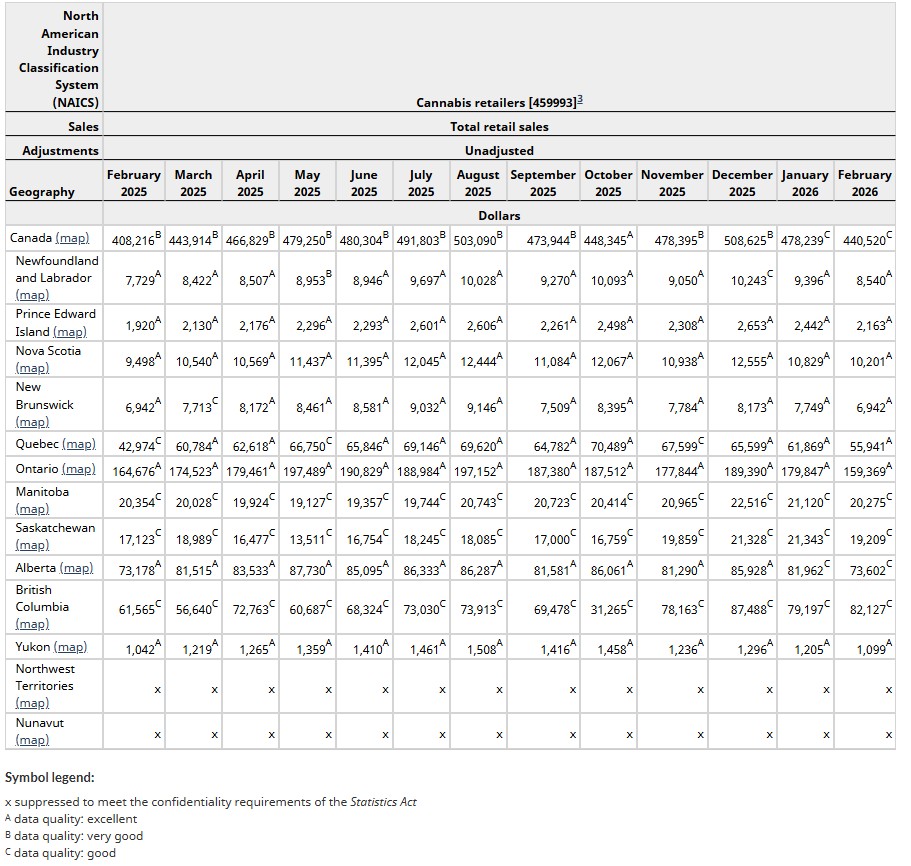
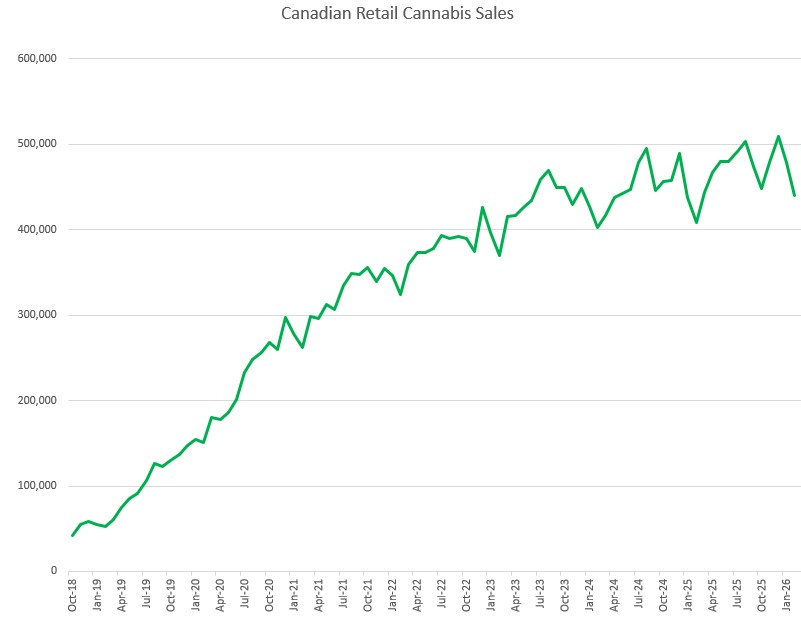
Cannabis markets outside the US continue to grow. Canada revised its federal medical cannabis program in 2013, with the MMPR replacing the MMAR, and the current Access to Cannabis for Public Purposes Regulations (ACMPR) replaced the MMPR in 2016. Justin Trudeau, who was elected Prime Minister in late 2015, became the first agenda item to legalize cannabis. implement adult use legalization in 2018. The program has its challenges, but the industry has grown as it has matured. StatsCan will release December sales data tomorrow, and it looks like cannabis sales are up about 4% for 2025.
Other countries have developed their own medical cannabis, including Australia, Germany and Israel, with Germany legalizing it for adult use. The Netherlands is holding trials in coffee shops. Uruguay, a small country, began legalizing cannabis sales to adults in 2017, and Germany began a program in 2024 to legalize cannabis for adults, although sales are through social clubs. While this program has not directly created commercial opportunities, it has boosted the market for medical cannabis. Unlike Canada, where cannabis is sold by the provinces, in Germany cannabis is sold in traditional pharmacies. A significant amount of medical cannabis sold in Germany is imported from Canada. David Brown of StratCann suggested this six months ago Almost 50% of German hemp imports in Q2 came from Canada.
The Global Hemp Stock Index, last recalculated at year-end, has 7 Canadian LPs, and these NASDAQ-listed companies tend to be active in international markets. Most MSOs in the US operate exclusively there, but one, Curaleaf, has international operations. Curaleaf trades on the TSX in Canada, but it trades in the US. The company reported total revenue of $320 million in its third quarter, with international operations (Canada, Germany, Portugal, Spain and the UK) accounting for just 14.4%. Year-to-date, it has registered just 12.9% as it has grown while domestic revenues have declined.
Canadian LPs in the index are Aurora Cannabis, Canopy Growth, Cronos Group, Organigram, SNDL, Tilray Brands and Village Farms. SNDL, which is more of an alcohol than cannabis retailer, has no international cannabis sales. The remaining six are active and active. This week, Organigram announced the acquisition of the rest of the German cannabis company, and it was already active in other markets. Cronos Group has announced the acquisition of CanAdelaar, a deal that is expected to close soon and will give it access to the Netherlands. Canopy Growth is acquiring MTL Cannabis, and increased exports of medical cannabis was a benefit he pointed to.
In: warned about Canadian LPs here at the end of November and I am now more optimistic about this part of the cannabis market. At the time I had 5 of the 7 GCSI members on my Focus List at 420 Investor, but I added Aurora Cannabis when they reported their financial Q3 and fell. Here’s how all 7 have performed since the end of November.
My 420 Investor model portfolio includes a small position in Tilray Brands, a large position in Aurora Cannabis, and a very large position in Organigram. These three positions represent 31.9% of the portfolio, while the GCSI has 27.4% exposure.
The Canadian LP market has certainly been cheaper than it is now, but it seems cheap enough. Balance sheets have improved dramatically, and some of these large companies are trading below tangible book value. NASDAQ listings are superior to the OTC listings that MSOs have. The Canadian market may improve, although I don’t expect it to, and international expansion may continue to help federally legal Canadian LPs export more or expand to other countries. These international operations also involve risks. I see a big international opportunity for Canadian LPs, and investors don’t seem very excited at the moment.
Sincerely,
Alan:
New Cannabis Ventures publishes curated articles as well as exclusive news. Here is what we have published in the last 2 weeks.
Follow Alan for real-time updates X.com:. Share and discover industry news with like-minded people on the largest group of cannabis investors and entrepreneurs LinkedIn:.
Stay on top of the most important communications from public companies by watching what’s coming cannabis investor calendar.
Based in Houston, Alan leverages his experience as an online community founder 420 Investorthe first and still the largest due diligence platform focused on publicly traded stocks in the cannabis industry. With his extensive network in the cannabis community, Alan continues to find new ways to connect the industry and facilitate its sustainable growth. time New Cannabis Ventureshe is responsible for content development and strategic alliances. Before turning his attention to the cannabis industry in early 2013, Alan, who began his career on Wall Street in 1986, worked as an independent research analyst with more than two decades of research and portfolio management experience. A prolific writer, with over 650 articles published since 2007 Looking for Alphawhere he has 70,000 followers, Alan is a frequent speaker at industry conferences and frequent source Media including the NY Times, Wall Street Journal, Fox Business and Bloomberg TV. Contact Alan. Twitter: |: Facebook |: LinkedIn: |: El