
Cannabis News
Greenhouse hygiene programs emphasize deep-penetration sanitation during cleanouts


During winter clean-ups, greenhouse operators prepare facilities for the next production cycle, with hygiene remaining a critical focus. Effective sanitation during crop transition plays a key role in reducing pathogen pressure and promoting long-term crop health, particularly in operations that manage virus risks such as Tomato brown rugose fruit virus (ToBRFV).
Disinfectants commonly included in greenhouse hygiene programs include Intra Multi Des GA, supplied in North America by Houweling Americas. “This product is widely used by vegetable and ornamental growers as part of comprehensive cleaning and routine sanitation strategies, especially where deep penetration is required on complex surfaces,” says the Houweling Americas team.
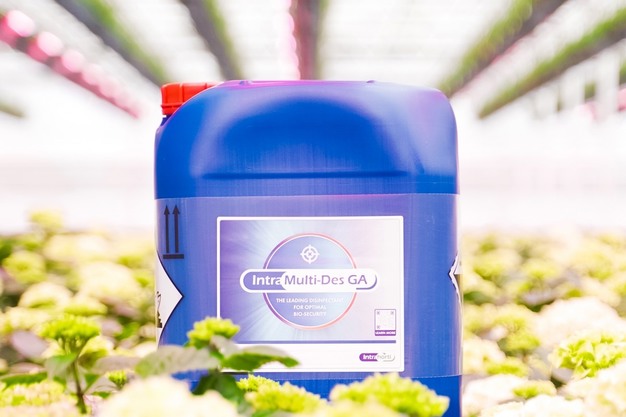 © Houweling Americas
Getting under the surface
Biofilms and organic debris continue to limit the effectiveness of many disinfectants, harboring microorganisms in cracks, crevices, and porous materials. According to the Multi Des GA technical team, the formulation is designed to address this challenge through penetration rather than surface activity.
“Intra Multi Des GA has five active ingredients that work together to provide strong penetration properties, allowing the product to reach microorganisms hiding in difficult access areas,” the team explained. While not positioned as a dedicated biofilm remover, the formulation is intended to reveal and eliminate pathogens sheltered beneath biofilm layers.
For best results, a two-step sanitation approach is recommended: deep cleaning to remove organic matter and biofilm, followed by disinfection. “Skip the cleaning step increases the risk of completely eliminating pathogens,” the team noted, highlighting the continued opportunity for farmer education around proper hygiene sequencing.
The role of cleaning before disinfection
As part of the Intracare product portfolio, Houweling Americas also supplies Intra Foam Organics, a cleaner designed to remove organic material prior to disinfection. Organic debris can significantly reduce disinfectant performance if not completely removed, especially on high-traffic or porous surfaces. When used as a first step, cleaners like Intra Foam Organics help ensure that disinfectants can come into direct contact with target pathogens.
Performance on porous and uneven surfaces
Concrete floors, block walls and other porous greenhouse materials remain among the most difficult areas to sanitize. According to internal tests, Intra Multi Des GA works reliably on these surfaces, moving into the micro-cracks where pathogens can persist.
“When applied to porous materials such as concrete blocks, the formulation moves significantly across the substrate,” the team explained. “This behavior is different from traditional disinfectants that remain on the surface and do not reach the embedded microorganisms.”
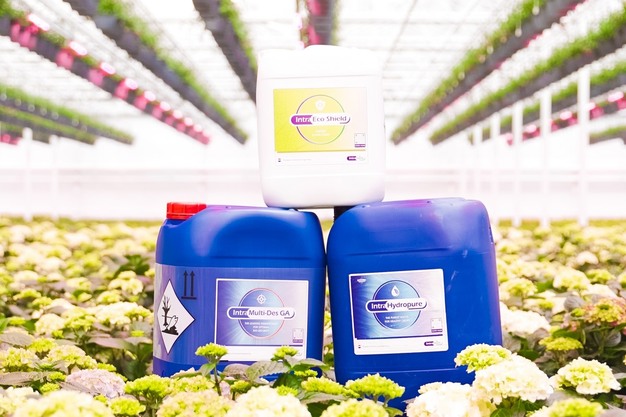 © Houweling Americas
Broad spectrum pathogen control
Growers of all types of crops rely on Intra Multi Des GA to manage a wide range of pathogens, including fungal, bacterial and viral threats. The reported efficacy against ToBRFV has made it an essential component of hygiene protocols in tomato production.
“Intra Multi Des GA has shown excellent efficacy against ToBRFV and has proven effective in eliminating the virus on contact when used appropriately,” the team reported. Beyond viral control, growers also use the product against pathogens such as Fusarium and Pythium in crop and ornamental systems.
Waste behavior and crop turnover
Unlike non-residue disinfectants, Intra Multi Des GA is designed to leave a residual effect on treated surfaces during cleaning, providing extensive protection between crops. This waste is not intended to come into contact with the collected products, but is used to maintain sanitation during downtime.
Operational efficiency is another matter. The product is applied at a low concentration of use, requires a short contact time and usually requires only one application, allowing rapid crop rotations without compromising hygiene standards.
Long-term sanitation results
Growers who consistently incorporate Intra Multi Des GA have reported cumulative improvements in crop rotation hygiene programs over multiple seasons. In one documented case, a Dutch tomato operation managing ToBRFV reported no subsequent infections after integrating the product into the cleaning protocol.
“Starting clean remains one of the most effective ways to reduce the risk of early cycle infection,” the team emphasizes.
Supporting North American producers
Houweling Americas supplies Intra Multi Des GA and other Intracare solutions through established distribution partners and provides technical support to assist with implementation. In addition to hygiene products, the company’s portfolio includes nutrient solutions, growing substrates, LED lighting, water treatment technologies and biostimulants such as Intra Eco Shield, with Intra Boost, a next-generation willow bark-derived biostimulant, scheduled for a North American launch in early 2026.
Based in British Columbia and Ontario, Houweling Americas works closely with growers to develop integrated solution programs that support yield, plant health and resilience. The company is part of Royal Houweling, a Dutch family business founded in 1925 and recently recognized with royal status for its long-term commitment to horticulture and sustainability.
For growers seeking technical guidance on hygiene protocols or product performance, the Houweling Americas team encourages direct engagement for further assistance.
For more information:
Houweling America
1-800-252-5824
houwelingamericas.com












Evidena Care AG is one of the leading Swiss telemedicine platforms and specialized medical practices for medical cannabis. The company currently supports more than 2,000 patients across the country. Under the direction of Dr. Nicolai Berardi and two other specialist doctors, Evidena Care has focused on evidence-based, responsible and patient-centered treatment for the past two years.
Now, Evidena Care is launching a nationwide online comparison portal for medical cannabis products. The platform is designed for patients who already have a valid medical prescription and want a clear and reliable view of the market. For the first time in Switzerland, patients can directly compare products and prices from the country’s largest pharmacies in one place.
Medical cannabis plays an essential role in the treatment plans of many patients. At the same time, prices can vary significantly between pharmacies, even when the products contain the same levels of active ingredients. As these costs are often not covered by health insurance, or only partially covered, many patients have a heavy financial burden. The new portal addresses this issue by bringing transparency to a market that until now has been difficult to navigate.
The platform provides an overview of available products and dosages, clearly lists the active ingredient content, such as THC and CBD levels, and displays the current prices of leading Swiss pharmacies. Patients can directly compare options and make informed decisions that help optimize their therapy costs, without compromising medical guidance.
“Patients should not be victims of non-transparent pricing structures,” says Dr. Nicolai Berardi, CEO of Evidena Care AG. “We are creating transparency with our comparison portal, strengthening the self-responsibility of those affected and promoting fair competition in the interests of patients.”
The portal is only for people with a valid prescription. It serves as a true information tool and supports cost optimization in an existing therapy supervised by a physician.
For more information:
Evidena Care AG
Email: (email protected)
https://evidena.care/
Cannabis News
Virginia Lawmakers Advance Marijuana Resentencing Bills As Push To Legalize Commercial Sales Also Nears Finish Line

Virginia’s House and Senate lawmakers have advanced a pair of bills with amendments that would allow people with prior marijuana convictions to be sentenced.
Members of the Senate and House Judiciary Committees on Monday approved alternate versions of the reform bill in opposite chambers, setting the stage for bicameral negotiations as the measures move through the legislative process.
Broadly, the legislation introduced in both chambers would create a process to consider changing the sentences for people incarcerated or on community supervision for certain crimes involving the possession, manufacture, sale or distribution of marijuana.
The Senate panel approved it HB 26 In a 9-6 vote by Del. Rozia Henson (D), with revisions largely consistent with the House bill, SB 62that is being backed by Senate President Pro Tem Louise Lucas (D). passed on the floor last month before going Home.
Senators have now referred the House measure to the Senate Finance and Appropriations Committee for further consideration.
There are some differences between the sizes of the chambers. The House-passed legislation includes minors who would be eligible for relief from marijuana-related convictions, clarifies that judges would only consider convictions for cannabis offenses and specifies that the reform would include people with marijuana-related probation violations.
Both proposed bills apply to people with convictions or convictions for conduct that occurred before July 1, 2021, when a state law legalizing personal possession and home cultivation of marijuana went into effect.
As for the Senate bill, which clean up The House committee’s 15-7 vote Monday would have eliminated more categories of people who could be eligible for the sentence as an alternative, and would add a longer list of violent crimes that make people with cannabis convictions ineligible for relief.
Against the background of these recent developments, Virginia bills to legalize the sale of recreational marijuana have moved forward in the way of implementing laws. Last week, members of the Chamber of Deputies and the Senate modified and advanced the proposals of the opposite chambers on the subject.
Members of the Virginia Legislature Last month, he took action on multiple marijuana bills during a major deadline—advance proposals to legalize the sale of cannabis, provide a way to punish previous marijuana convictions, as well as other laws to allow access to medical cannabis for seriously ill patients in hospitals.
Despite their stark differences, the two chambers’ trade sales bills have largely aligned with recommendations released by the legislature in December. Joint Committee to Oversee the Transition to the Commonwealth Retail Cannabis Market.
Meanwhile, some members of the GOP have aligned ideologically with their Democratic colleagues throughout this legislative process, breaking with the majority of their caucus. in favor of creating a regulated market for adults to buy cannabis.
Since legalizing cannabis ownership and home cultivation in 2021, Virginia lawmakers have been working to establish a commercial marijuana market– Only for those efforts to stall under former Gov. Glenn Youngkin (R), who twice vetoed measures sent to his desk by the Legislature.
Gov. Abigail Spanberger (D), on the other hand, supports legalizing the sale of marijuana to adults.
Separately last month, the Virginia House patients passed a bill to allow the use of medical marijuana in hospitals. It would require health care facilities to implement policies “to address the situation in which an eligible patient is authorized to use medical cannabis.”
The Senate passed various pieces of legislation use of medical cannabis in healthcare facilities last month
—
It’s Marijuana Time tracking hundreds of cannabis, psychedelic and drug policy bills in state legislatures and Congress this year. Patreon supporters by pledging at least $25/month, you’ll get access to our interactive maps, charts, and audio calendars so you never miss a development.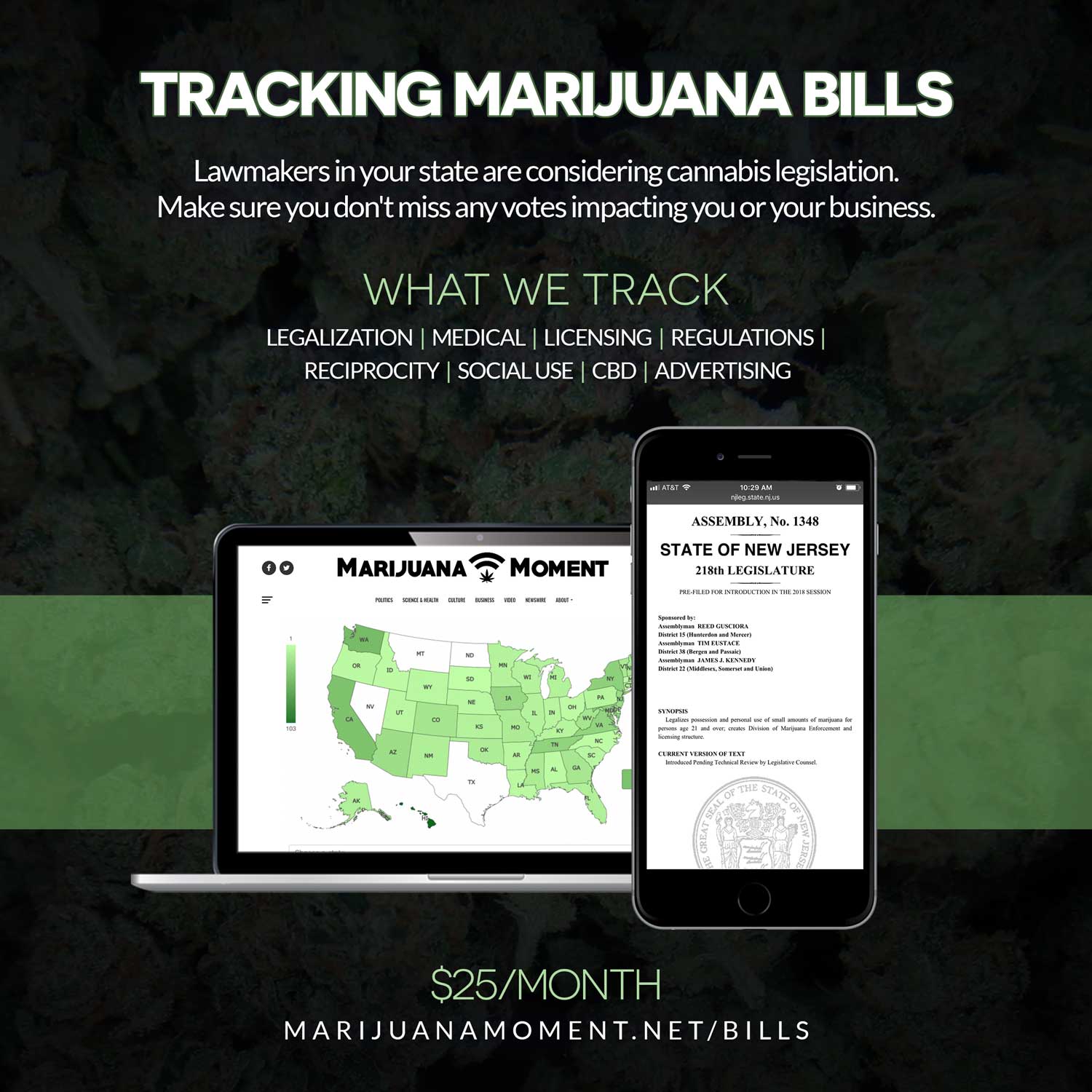
Learn more about our marijuana bill tracking and become a Patreon supporter to gain access
—
Meanwhile, the Virginia House passed the bill earlier this month Protecting the rights of parents who use marijuana by complying with state laws.
Del. According to the proposal by Nadarius Clark (D), a parent or guardian’s own use of cannabis “shall not serve as a basis for a finding of abuse or neglect of a child unless other facts establish that its possession or consumption causes or produces physical or mental injury to the child.”
“A person’s legal possession or consumption of substances permitted (under state marijuana law) shall not serve as a basis for limiting custody or visitation unless other facts establish that such possession or consumption is not in the best interest of the child,” reads the text of HB 942.
Separately, the Virginia Department of Labor and Industry has published a new defining workplace protections for cannabis users.
Marijuana Moment is made possible with the help of readers. If you rely on our pro-cannabis journalism to stay informed, consider a monthly Patreon pledge.



A bill that would allow Oklahoma counties to impose a tax on retail marijuana sales has passed a committee in the Oklahoma House of Representatives.
Under the Oklahoma Legislature, House Bill 3314, authored by Rep. Ryan Eaves, R-Atoka, would allow counties to impose a tax of 15 percent of the impact of public utilities within county boundaries. The bill is similar to Senate Bill 1125, introduced by state Sen. Dusty Deevers, R-Elgin, in the Oklahoma Senate during the 2025 legislative session. SB 1125 would allow counties and municipalities to levy an excise tax on medical marijuana.
HB3314 passed the House County and Municipal Government Committee on a 6-0 vote, and now moves to the Government Oversight Committee for further consideration. The invoice does not automatically generate tax. If a county chooses to join, it must first be approved by a majority of the county’s voters in a special election. The bill also exempts marijuana grown on private property by individuals and not sold.
“Countries are the ones dealing with the daily impact of marijuana sales,” Eaves said. “This allows local communities to decide for themselves whether they want to allocate a portion of that revenue to law enforcement, first responders and improving problem properties.”
Read more at News 9

New York Cannabis Processors Face Deadline To Implement ‘Seed-To-Sale’ System

Swiss company launches nationwide price comparison tool for cannabis

Virginia Lawmakers Advance Marijuana Resentencing Bills As Push To Legalize Commercial Sales Also Nears Finish Line

Grow Up Conference Lifetime Achievement Award

What is a Hemp House? Texas AG Sues Dallas! Univ. of AZ gets a testing lab; Coast to Coast News

Stretchy, Sick Seedlings? Here’s How to Save Them

CANNABIS CARE | BENJAMIN CAPLAN, M.D.

Major Colorado Cannabis Retailer Sued Over Six-Figure Bill

Trulieve Q4 Revenue Falls 3% – New Cannabis Ventures

State counties could tax medical marijuana sales under a new House bill

“Our system can manage equipment across 10,000+ m² using just a few wires”

Florida Workshop to Discuss What Constitutes a ‘Cartoon’ in Hemp Packaging

Mazar-i-Sharif Hash Wednesday

Your Cannabis Business: Consistent Filings Are Critical

Re-release of the full show of Cannabis Coast to Coast news. Republican Texas DA Fires Up vs. laws;

DEA’s Cole Reverses His “priorities” ; Prohibitionists Dig In; Dead & Co Celebrates 60 years in SF

From Finance to Wellness: Brad Zerman’s Impactful Pivot

Texas DA Partakes on Tik Tok to prove a point; Boston Sheriff arrested for Extortion of $ w/ Ascend

Weak Michigan Cannabis Sales Again in July – New Cannabis Ventures

New Hampshire Governor Says Federal Marijuana Rescheduling Won’t Change Her Opposition To Legalization
-
 Cannabis News6 months ago
“Our system can manage equipment across 10,000+ m² using just a few wires”
-
 Florida7 months ago
Florida Workshop to Discuss What Constitutes a ‘Cartoon’ in Hemp Packaging
-
 Video5 months ago
Mazar-i-Sharif Hash Wednesday
-
 Best Practices7 months ago
Your Cannabis Business: Consistent Filings Are Critical
-
 Video7 months ago
Re-release of the full show of Cannabis Coast to Coast news. Republican Texas DA Fires Up vs. laws;
-
 Video6 months ago
DEA’s Cole Reverses His “priorities” ; Prohibitionists Dig In; Dead & Co Celebrates 60 years in SF
-
 Video7 months ago
From Finance to Wellness: Brad Zerman’s Impactful Pivot
-
 aawh7 months ago
Weak Michigan Cannabis Sales Again in July – New Cannabis Ventures