
Cannabis News
Nighttime humidity is not a problem that needs to be vented away


Night hours present a persistent and costly challenge for commercial greenhouse operators. When the thermal screens are closed and the ventilations are closed, the greenhouse is closed, trapping the moisture produced by the crop. This creates a high-stakes battle against condensation, disease and unnecessary energy loss. Amir Kandlik, B.Sc. Plant Science and Genetics in Agriculture and agronomist with Drygair explores the critical problem of nighttime humidity and explains the strategic shift from traditional ventilation-based control to a system built around active indoor dehumidification. “This ‘closed greenhouse’ approach improves energy efficiency and supports stronger crop health.”
 © Drygair
Night challenge: Thermodynamic and pathological risk
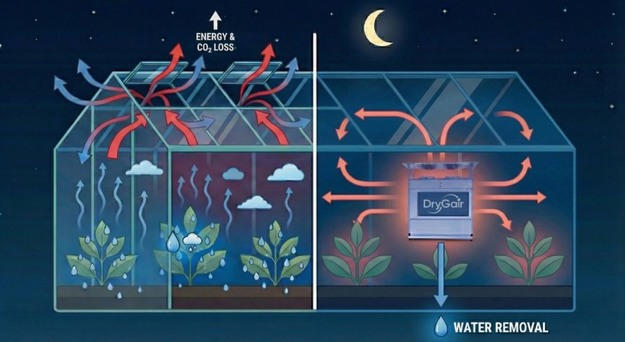
“At night, plants continue to transpire even though photosynthesis has stopped. Without the drying effect of daytime conditions, the air mass in the greenhouse quickly approaches saturation,” says Amir. “Traditional methods rely on ventilation, but ventilation replaces warm, CO₂-rich air with cold outside air. This increases heating demand, destabilizes temperatures and can introduce more moisture, especially in humid weather.”
A variation of this, heating the air before it is vented, wastes energy because the air conditioner is blown out immediately. “In cold, rainy, or snowy conditions, ventilation becomes impossible and humidity increases unchecked. As relative humidity rises above 85 percent and temperatures drop, surface temperatures can drop below the dew point. Condensation then forms on leaves, fruit, and structural elements, creating conditions that promote Botrytis, powdery mildew, and powdery mildew.”
Solution: “Closed” paradigm with active dehumidification.
A more advanced strategy replaces night ventilation with active internal dehumidification, keeping the greenhouse closed. Amir explains that it starts when the unit pulls in moist air, cools it below its dew point and condenses the water vapor into liquid form. “The latent heat released by condensation is captured and recycled, heating the dry air before redistributing it throughout the cottage. Instead of losing heat to dryness, this method converts moisture into heat and creates a net positive energy cycle.”
 © Drygair
Basic advantages of the closed night strategy
This approach improves disease prevention by maintaining a stable vapor pressure deficit and preventing dew formation. Keeping surfaces above the dew point significantly reduces disease pressure. Flower tests recorded a 98% reduction in Botrytis when relative humidity remained below 85%. Energy efficiency is also increased because the airfields remain closed and latent heat is recovered during dehumidification. Vegetable producers have reported energy savings of 50%.
“Climate uniformity is improved as constant air circulation removes microclimates, and sealed conditions store CO₂ for uptake at dawn,” says Amir. Crop quality and yield benefit from consistent transpiration and improved movement of nutrients and calcium. Basil had a 15 percent yield increase without downy mildew, and unheated tomato houses had a 25 percent higher yield per stem.
Practical settings for leaders
Adopting this strategy requires changing the operational logic, which is usually handled by a climate computer. “During the day, the vents are open and the natural ventilation manages the humidity, so the dehumidifiers are turned off. At night, when the outside temperature drops below the indoor set point, the vents and screens close, and the dehumidifier operates at an RH of about 75 to 80 percent. The priority is to maintain a dew point range of at least 2 degrees. While heating is used only for temperature stability, nighttime temperatures stay below 10 degrees Celsius. in regions with , an additional defrost coil is required for continuous operation.
Looking at the field results
Field studies show that flowers grown according to this strategy maintained lower relative humidity, achieved significant energy savings and did not require night ventilation. Basil trials showed a 15 percent increase in yield and zero downy mildew. Tomatoes and peppers have seen a 5 to 25 percent increase in yield and a 98 percent reduction in disease. Cannabis growers recorded 30 to 40 percent higher yields with about 50 percent energy savings.
Specific questions about geography and climate
In very cold climates, this view is especially good. Ventilating at minus 10 degrees Celsius creates an extreme heating load, and sealing the greenhouse and dehumidifying the interior retains heat, recovers latent heat and reduces boiler use. In hot and humid climates, night ventilation is unreliable during warm or rainy weather. Active dehumidification removes moisture in a controlled manner, and with additional Air-Water Heat Exchange, the system can heat or cool the air through an external water loop.
Supporting scientific and technical references
Research includes Elad and Shtienberg’s work on Botrytis cinerea, University of Massachusetts Extension greenhouse moisture reduction guidance, Stanghellini’s transpiration studies, and Ho and Adams’ work on water and nutrient uptake in tomatoes.
Without ventilation
“Nighttime humidity is not a problem to be banished, but an imbalance to be managed,” says Amir. “The closed greenhouse strategy treats moisture as an energy resource instead of a waste product. By keeping greenhouses closed at night and using active internal dehumidification, growers can reduce disease, improve energy efficiency, retain CO₂, stabilize the nighttime climate, and increase yield and crop quality. This is one of the most impactful changes in modern greenhouse climate management.”








Cannabis News
German state authority says cannabis flower must be dried where it’s grown, tightening the screws on EU GMP washing

In Hesse, medicinal cannabis flowers must be dried and cut where the plants are harvested, the Hessian State Office for Health and Care says in a June 8 guidance letter, unless a grower can prove beyond doubt that skipping or splitting the drying does not result in a loss of quality.
The document treats drying under controlled conditions as a critical manufacturing step that affects product quality, which places its parameters within GMP standards rather than the more lenient GACP standard that governs cultivation (source: HLfGP brochure). Annex 7 of the GMP guideline allows coarse cutting and possibly a primary drying step under GACP conditions, but only when the work actually falls within these limits and the quality of the drug is not compromised. The authority says it does not have a process that has allowed flowers that can be classified as GACP material to be transported over long distances, stored, imported and further processed without loss of quality. Either the requirements for GACP flower are not met because the handling goes beyond the initial drying and coarse cutting, or the flower cannot be shown to survive longer storage and transport without degrading before subsequent steps.
 © Philiprowe | Dreamstime
What a third country allows does not change that. According to the authority, if the cannabis flower is partially manufactured in a country where the GMP guideline does not apply, the guidelines must still be met for material released and sold as medicine in Germany. The responsibility lies with the Qualified Person under the German Medicinal Products Act who releases the flower for sale, and is responsible, even if partial manufacturing takes place in sites operating under different regulations in other EU states or third countries.
This is the mechanism behind EU GMP clearance, the practice of converting imported flowers through a European facility to obtain certification that the original material would not otherwise carry. The Hesse letter does not use that term. What it does is to close the interpretation loophole that allows a partial dry abroad to be finished and certified in Europe, by calling the dry finish a GMP step that cannot be cleared through a GACP origin.
The policy also restricts reprocessing. According to Chapter 5 of the EU GMP guideline, reprocessing is only possible in exceptional cases, under strictly defined conditions and a full risk assessment, which includes drying or reducing the microbial load. Batches undergoing such steps cannot be sold without proof of suitability and stability, and when rework is applied to most batches, it should become a validated part of the standard process.
A producer active in the supply chain, who asked not to be named, says the Hesse letter is one of two recent moves, covering the second-issued Darmstadt district, in line with the regions already taking a stand against EU GMP clearance in Cologne. In the accounts of this grower, the regions have closed the loophole that allowed partial drought in a country like Colombia to end in Germany, Darmstadt has refused to allow this conversion in its territory.
The most difficult case, according to this producer, is the multi-country chain. The flower partially processed in Colombia, sent to Portugal and converted there according to the EU GMP is still something that Germany completely rejects, although it should be caught by a qualified person who does the job properly, and a chain that goes to a third country, according to the producer’s estimates, approximately ninety percent is not allowed. Qualified people have more responsibility than before, and when they check the supply line and find the chain invalid, the Darmstadt regional authority would look into it.
Cannabis News
Marijuana Opponents Attack Government Analysis Behind Rescheduling Recommendation On Second Day Of DEA Hearing

Entourage Health Corp. has entered creditor protection. The company and six related entities filed on June 17 under the Companies’ Creditors’ Arrangement Act owed approximately $240.1 million to the sole affiliate of the LiUNA Pension Fund, its owner, its secured creditor and the lender that is now funding the money (First Report pp. 3-6-9
That affiliate, 2437653 Ontario Inc. No. 1 company, Entourage, secured a 2024 deal that took the former WeedMD private and off the TSX Venture Exchange (December 2024 PR). Shareholders were paid half a Canadian cent per share, or C$0.005, and the board recommended a sale in December 2024 (December 2024 PR).
Jason Alexander, head of the special committee of independent directors, recommended to shareholders. “The transaction ensures that shareholders will receive immediate tangible value while positioning the Company for future growth and flexibility,” Alexander said (December 2024 PR). The company took on $167.6 million in debt in that sale, having already breached the covenant with the same guarantee (December 2024 PR). Eighteen months later that debt was $240.1 million when it was filed, and the growth promised by the sale is a settlement (First Report 6-18 p.

Adult use is off, medical is still running
The leisure business is closing, not saving. Entourage laid off about 53 workers in early June before the order, and 22 remain (First Report p. 6 Adult use inventory is being cleared, finished products are shipped to provincial distributors, and flowers are sold in bulk to the market to other licensed growers (First Report p. 12 Color Cannabis, Dime Bag and Saturday Cannabis are the brands going down with it (First Report p. 5
What remains open is the doctor’s arm as the exclusive supplier of cannabis under the Starseed brand to local residents of the Workers International Union of North America (First Report p. 5 The pension fund that funds the procedure is tied to the same union that the medical brand serves, and the part of Entourage that serves union members is the part that is kept alive while the rest is sold for parts.
At the end of July the money runs out with no new money (First Report p. 11 The money comes again from the pension fund affiliate, a $1.1 million debtor-in-possession facility at 5% per annum, no commitment fee, no exit fee (First Report pp. 10-11). The monitor, Ernst & Young, checked terms against other DIP loans in the cannabis sector from January 2024 and concluded that a third-party lender would not lend on better terms given the state of the business (First Report p. 11 The lender, which already owed $240 million, is the only one willing to advance another million to keep the lights on through the sale.
Health Canada is the largest unsecured creditor, owed $494,505, ahead of all suppliers and competitors on the company’s books (List of Creditors p. 1 Supreme Cannabis is owed $262,133, medical platform HelloMD is owed $169,564, the Town of Aylmer is owed $144,815, the Independent Retail Cannabis Board is owed $137,098 and High Tide is owed $124,583 (List of Creditors p. 1 Unsecured claims total $3,288,333 in more than 100 names, many of which have yet-to-be-determined amounts by medical clinics (List of Creditors 1-5 p. Against $240 million guaranteed, none of them will see much.
In the June 29 return, the lender asks the judge to extend the stay until August 28, approve the DIP facility, and double the Administrative and Directors fees to $500,000 each (First Report 4-8-12. p. The directorship is rising as directors face payroll, holiday pay and excise duties over a longer period of time, and the company’s directors and officers insurance expires at the start of July (First Report p. 12
The sales process starts on the same day, based on a marketing effort that started around May and was presented before the deal that sparked interest but no one could make a deal (First Report p. 13 Insiders and affiliates have until July 6th to say they intend to bid, the bid deadline is July 30th, the successful bid must be received by August 7th, and the outside deadline is August 28th (First Report p. 15 The affiliate of the pension fund has written to the Monitor that it will not make an offer (First Report p. 16), and any other affiliate that does so must be removed from the process (First Report p. 16 The settlement request for non-cannabis equipment and the sale of the Aylmer facility, a 26,000-square-foot extraction and processing facility that has been the company’s production base at 250 Elm St.
For more information:
Neighborhood Health
1.844.933.3636
(email protected)
entouragehealthcorp.com

Marijuana Retail Report

German state authority says cannabis flower must be dried where it’s grown, tightening the screws on EU GMP washing

ALJ Hearing Week: What To Watch For

Marijuana Opponents Attack Government Analysis Behind Rescheduling Recommendation On Second Day Of DEA Hearing

Glass House Brands Begins Trading on NYSE

Weed Talk News with Alaina Pinto The B Block -5-29-24

CANNABIS CAREERS | KARSON HUMISTON

Marijuana Retail Report

Entourage Health, formerly WeedMD, enters creditor protection

DEA And FDA Highlight How Marijuana Is Safer Than Alcohol And Opioids During Rescheduling Hearing’s Opening Day

“Our system can manage equipment across 10,000+ m² using just a few wires”

Florida Workshop to Discuss What Constitutes a ‘Cartoon’ in Hemp Packaging

Mazar-i-Sharif Hash Wednesday

Afghan Black Hash Wednesday

Weak Michigan Cannabis Sales Again in July – New Cannabis Ventures

From Finance to Wellness: Brad Zerman’s Impactful Pivot

DEA’s Cole Reverses His “priorities” ; Prohibitionists Dig In; Dead & Co Celebrates 60 years in SF

Re-release of the full show of Cannabis Coast to Coast news. Republican Texas DA Fires Up vs. laws;

Curaleaf Q2 Revenue Falls 8% – New Cannabis Ventures

Your Cannabis Business: Consistent Filings Are Critical
-
 Cannabis News10 months ago
“Our system can manage equipment across 10,000+ m² using just a few wires”
-
 Florida11 months ago
Florida Workshop to Discuss What Constitutes a ‘Cartoon’ in Hemp Packaging
-
 Video9 months ago
Mazar-i-Sharif Hash Wednesday
-
 Video9 months ago
Afghan Black Hash Wednesday
-
 aawh11 months ago
Weak Michigan Cannabis Sales Again in July – New Cannabis Ventures
-
 Video11 months ago
From Finance to Wellness: Brad Zerman’s Impactful Pivot
-
 Video10 months ago
DEA’s Cole Reverses His “priorities” ; Prohibitionists Dig In; Dead & Co Celebrates 60 years in SF
-
 Video11 months ago
Re-release of the full show of Cannabis Coast to Coast news. Republican Texas DA Fires Up vs. laws;