
Cannabis News
San Marino MMJ grower hits perpetual cycle, gets ready to hit EU market


Osasun Farma has finally pushed its continuous growth into full motion. After a long year of testing and quiet adjustments, the San Marino crop is churning out roughly 20kg every 20 days, a steady pace that founder Ruggero Stacchini describes as satisfying and yet challenging. “We are happy. It is going well. We have some contacts to sell in the European market and we are waiting for the documentation,” he says. The team is learning fast, especially on the analytical side. “In the beginning the problem was analysis. Now we know how to do everything. So we are on the sales side.”
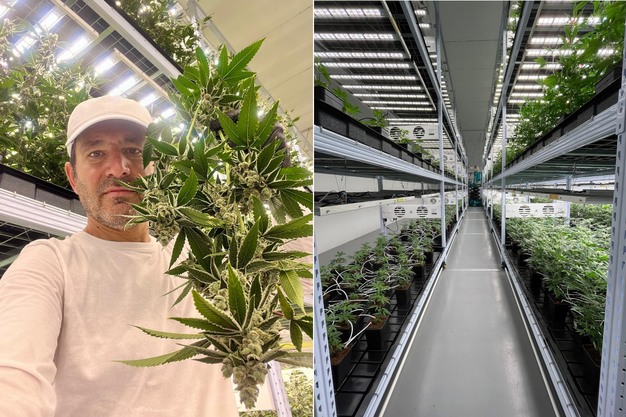 © Health Farm srl
Ready to enter the market
Ruggero explained that communication with the San Marino agencies is going quite well. The real challenge is to face the international stage. “With San Marino, we are very fast. The relationship with the medical cannabis authority is great and within a few days, we get answers. It’s about fully understanding how things work outside. We’re not there yet, and we want to understand who we’re dealing with and how the market works.”
That’s why Health Farm has shopped around Europe to get a clearer picture. “We are looking at Luxembourg, the Netherlands, Germany, France, Greece, Portugal. We have made connections in all these markets, including Italy.”
On the research side, the company has an agreement with the San Marino authorities and local pharmaceutical workshops to train doctors and start clinical-style trials. “Doctors in San Marino, like in Italy, are not prepared for this type of treatment. We want to do courses and experiments.”
 © Health Farm srl
“Quality comes at a cost”
The company is also looking for European pharmaceutical partners capable of processing the flower into finished products such as oil or rosin for both domestic and European distribution. The challenge, as Ruggero points out, is the price landscape. “Some of the prices are too low. We are here in Europe and we see numbers that don’t really add up. Quality has a cost. Probably the distribution earns more than the producer of the quality product. The market is demand and supply, but still. We want to understand how it works in the European market without shortcuts.”
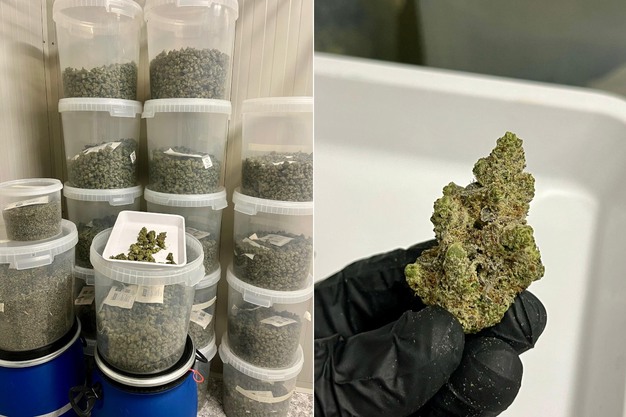
In the meantime, Osasun Farma has the product ready to ship. “We have the product finished, assembled, cut, COA done, ready for the market. We are talking to different potential partners. But first, we want to understand the market well.”
The output will continue to grow. “As of now, we are harvesting 20 kg of flowers plus 10 kg of cutting material every month. But we have the potential to double our production. However, for now, we have not gone all in before landing on the market.”
 © Health Farm srl
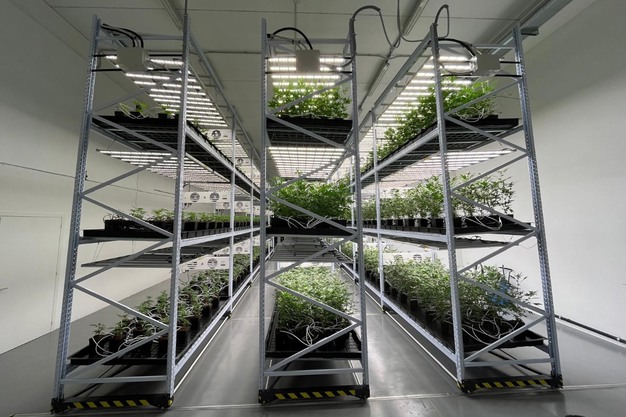
After a year of testing cycles, it seems to be giving a full run forever. “We improve every day with continuous cycles. As in any horticultural business, we face daily crop challenges, but now we are in full production.”
The goal is simple. “We want to hit the market because we feel ready. We did a whole year of training to get a high quality product. It’s not just us and our COA saying that. We’ve been told that the terpene profile of our flowers is very unique.” Laboratory tests have actually shown that Health Farm flowers contain not only 20% THC, but also 1.4% terpene content, which may find applications for a variety of medical conditions. “We hope to offer this to patients in Europe,” concludes Ruggero.
For more information: © Health Farm srl
health farm
Via Biagio di Santolino 39 – 47892 Acquaviva RSM
+39 0549960429
(email protected)
healthyfarmsm.com









The South African Department of Agriculture has announced that the Plant Improvement Act 2018 (Act 11 of 2018) and accompanying regulations came into force on 1 December 2025. President Cyril Ramaphosa signed the proclamation of the new Act after Agriculture Minister John Steenhuisen approved the regulations. The Act replaces the Plant Improvement Act 1976 (Act 53 of 1976). Both the proclamation and its regulations were published in Official Gazette 53707 of November 21, 2025.
The updated legislation establishes systems for the registration of businesses related to plants and propagating materials for cultivation and sale, as well as the registration of the premises where these businesses operate. It also establishes quality standards for plants and propagating material, determines sales conditions and establishes a national list of plant varieties. The law includes processes for evaluating plant varieties when there is uncertainty about their value for cultivation and use, and strengthens import and export control of plants and propagating material. Certification schemes for plants and propagating material are also part of the framework.
The 2018 Act introduces new provisions that were not included in the 1976 Act. These additions include the registration of businesses related to plants and propagating material, along with new rules for the cultivation of Cannabis sativa L. (hemp) varieties in South Africa. The revised definition now classifies hemp as a low tetrahydrocannabinol (THC) plant or plant part containing no more than 2 percent transdelta 9 THC, a change from the previous limit of 0.2 percent. The Act also provides for the publication of a Gazette of the National List of Varieties and specifies the process for hearing claims submitted to the Registry in connection with applications for the National List of Plant Varieties. In addition, the Law establishes an advisory committee that can assist the Registry in technical or administrative matters related to its implementation.
According to the department, the Plant Improvement Act creates a legal framework for the production and sale of high-quality seeds and vegetative propagation material. This framework supports the productivity and long-term sustainability of food production in South Africa.
Source: South African Government News Agency
Cannabis News
Trump’s Marijuana Order Means Congress Must Delay The Federal Hemp Ban’s Timeline (Op-Ed)

During winter clean-ups, greenhouse operators prepare facilities for the next production cycle, with hygiene remaining a critical focus. Effective sanitation during crop transition plays a key role in reducing pathogen pressure and promoting long-term crop health, particularly in operations that manage virus risks such as Tomato brown rugose fruit virus (ToBRFV).
Disinfectants commonly included in greenhouse hygiene programs include Intra Multi Des GA, supplied in North America by Houweling Americas. “This product is widely used by vegetable and ornamental growers as part of comprehensive cleaning and routine sanitation strategies, especially where deep penetration is required on complex surfaces,” says the Houweling Americas team.
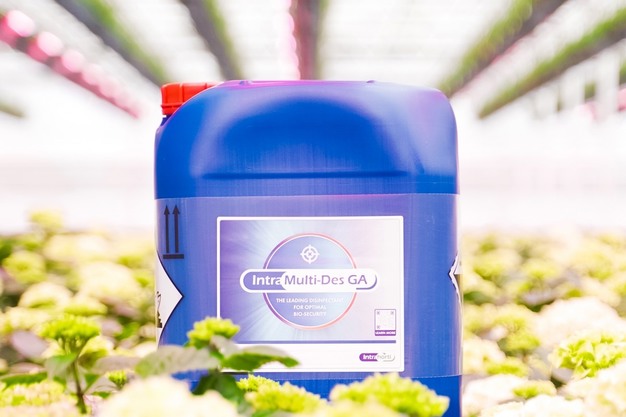 © Houweling Americas
Getting under the surface
Biofilms and organic debris continue to limit the effectiveness of many disinfectants, harboring microorganisms in cracks, crevices, and porous materials. According to the Multi Des GA technical team, the formulation is designed to address this challenge through penetration rather than surface activity.
“Intra Multi Des GA has five active ingredients that work together to provide strong penetration properties, allowing the product to reach microorganisms hiding in difficult access areas,” the team explained. While not positioned as a dedicated biofilm remover, the formulation is intended to reveal and eliminate pathogens sheltered beneath biofilm layers.
For best results, a two-step sanitation approach is recommended: deep cleaning to remove organic matter and biofilm, followed by disinfection. “Skip the cleaning step increases the risk of completely eliminating pathogens,” the team noted, highlighting the continued opportunity for farmer education around proper hygiene sequencing.
The role of cleaning before disinfection
As part of the Intracare product portfolio, Houweling Americas also supplies Intra Foam Organics, a cleaner designed to remove organic material prior to disinfection. Organic debris can significantly reduce disinfectant performance if not completely removed, especially on high-traffic or porous surfaces. When used as a first step, cleaners like Intra Foam Organics help ensure that disinfectants can come into direct contact with target pathogens.
Performance on porous and uneven surfaces
Concrete floors, block walls and other porous greenhouse materials remain among the most difficult areas to sanitize. According to internal tests, Intra Multi Des GA works reliably on these surfaces, moving into the micro-cracks where pathogens can persist.
“When applied to porous materials such as concrete blocks, the formulation moves significantly across the substrate,” the team explained. “This behavior is different from traditional disinfectants that remain on the surface and do not reach the embedded microorganisms.”
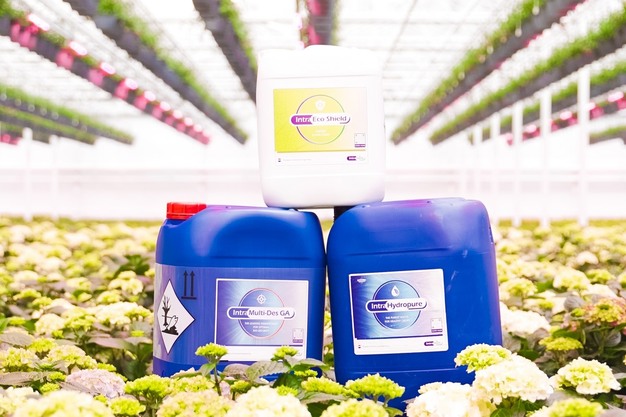 © Houweling Americas
Broad spectrum pathogen control
Growers of all types of crops rely on Intra Multi Des GA to manage a wide range of pathogens, including fungal, bacterial and viral threats. The reported efficacy against ToBRFV has made it an essential component of hygiene protocols in tomato production.
“Intra Multi Des GA has shown excellent efficacy against ToBRFV and has proven effective in eliminating the virus on contact when used appropriately,” the team reported. Beyond viral control, growers also use the product against pathogens such as Fusarium and Pythium in crop and ornamental systems.
Waste behavior and crop turnover
Unlike non-residue disinfectants, Intra Multi Des GA is designed to leave a residual effect on treated surfaces during cleaning, providing extensive protection between crops. This waste is not intended to come into contact with the collected products, but is used to maintain sanitation during downtime.
Operational efficiency is another matter. The product is applied at a low concentration of use, requires a short contact time and usually requires only one application, allowing rapid crop rotations without compromising hygiene standards.
Long-term sanitation results
Growers who consistently incorporate Intra Multi Des GA have reported cumulative improvements in crop rotation hygiene programs over multiple seasons. In one documented case, a Dutch tomato operation managing ToBRFV reported no subsequent infections after integrating the product into the cleaning protocol.
“Starting clean remains one of the most effective ways to reduce the risk of early cycle infection,” the team emphasizes.
Supporting North American producers
Houweling Americas supplies Intra Multi Des GA and other Intracare solutions through established distribution partners and provides technical support to assist with implementation. In addition to hygiene products, the company’s portfolio includes nutrient solutions, growing substrates, LED lighting, water treatment technologies and biostimulants such as Intra Eco Shield, with Intra Boost, a next-generation willow bark-derived biostimulant, scheduled for a North American launch in early 2026.
Based in British Columbia and Ontario, Houweling Americas works closely with growers to develop integrated solution programs that support yield, plant health and resilience. The company is part of Royal Houweling, a Dutch family business founded in 1925 and recently recognized with royal status for its long-term commitment to horticulture and sustainability.
For growers seeking technical guidance on hygiene protocols or product performance, the Houweling Americas team encourages direct engagement for further assistance.
For more information:
Houweling America
1-800-252-5824
houwelingamericas.com

Sunset Sherbet Marijuana Monday AT THE CANNABAR!

Is Legalization Dead in 2025? NORML Poltical Director Morgan Fox 1v1 with PCM TV’s Jimmy Young

👮Is Federal Legalization Really Happening This Time?

EVERYTHING HEMP | CHRIS BOUCHER

New Plant Improvement Act comes into effect

Trump’s Marijuana Order Means Congress Must Delay The Federal Hemp Ban’s Timeline (Op-Ed)

Bazooka Marijuana Monday at the NEW Cannabar!

Re-Rlease of Cannabis Coast to Coast News with Alaina Pinto; Is Cannabis being used the wrong way?

⭕️What Is THC-O? Is It Really 300% Stronger?

CANNABIS TITAN | ROBERT HOBAN

“Our system can manage equipment across 10,000+ m² using just a few wires”

Florida Workshop to Discuss What Constitutes a ‘Cartoon’ in Hemp Packaging

German Retail Acquisition Pending for High Tide – New Cannabis Ventures

Your Cannabis Business: Consistent Filings Are Critical

From Finance to Wellness: Brad Zerman’s Impactful Pivot

Re-release of the full show of Cannabis Coast to Coast news. Republican Texas DA Fires Up vs. laws;

Texas DA Partakes on Tik Tok to prove a point; Boston Sheriff arrested for Extortion of $ w/ Ascend

Cannabis Investors Should Consider REITs – New Cannabis Ventures

DEA’s Cole Reverses His “priorities” ; Prohibitionists Dig In; Dead & Co Celebrates 60 years in SF

Curaleaf Q2 Revenue Falls 8% – New Cannabis Ventures
-
 Cannabis News4 months ago
“Our system can manage equipment across 10,000+ m² using just a few wires”
-
 Florida4 months ago
Florida Workshop to Discuss What Constitutes a ‘Cartoon’ in Hemp Packaging
-
 Canadian Cannabis News4 months ago
German Retail Acquisition Pending for High Tide – New Cannabis Ventures
-
 Best Practices4 months ago
Your Cannabis Business: Consistent Filings Are Critical
-
 Video4 months ago
From Finance to Wellness: Brad Zerman’s Impactful Pivot
-
 Video4 months ago
Re-release of the full show of Cannabis Coast to Coast news. Republican Texas DA Fires Up vs. laws;
-
 Video4 months ago
Texas DA Partakes on Tik Tok to prove a point; Boston Sheriff arrested for Extortion of $ w/ Ascend
-
 Advanced Flower Capital4 months ago
Cannabis Investors Should Consider REITs – New Cannabis Ventures