
Cannabis News
Synthetic seeds show a glimpse of the future for cannabis breeding

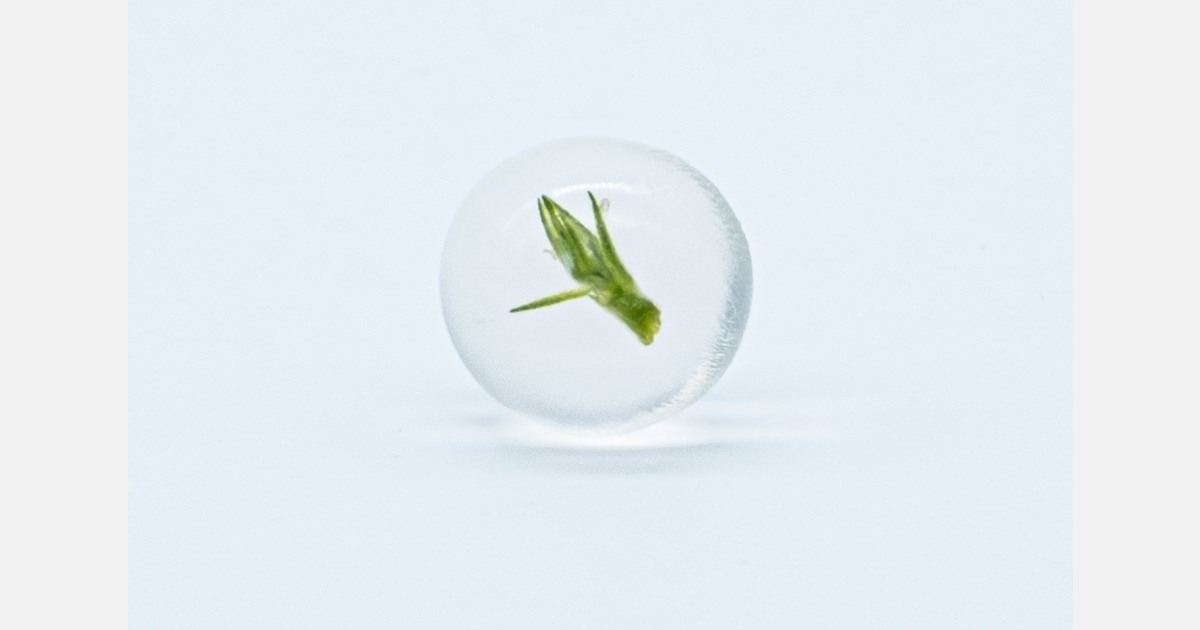
When tissue culture laboratories emerged in the 1970s, they quickly became the standard infrastructure for propagating tomatoes, corn, and dozens of other crops. Decades of scientific literature followed, refining formulas and SOPs that made the process reliable at scale. For cannabis, this body of knowledge does not exist, the consequences of the prohibition era. It’s a gap that companies like Microhemp, a tissue culture lab based in Italy, are now working to close. “Tissue culture labs have been around since the 70s,” says Marco Bianco, founder of Microhemp. “But when it comes to cannabis, this is a relatively new space.”
 © Microhemp
Set to empty
Scientific failure has made the setup unimaginable. “Tissue culture has been known inside and out since the 70s. Around Cesena, where we are, there are many laboratories, but they work with traditional plants. Italy produces millions of plants in tissue culture every year, but the cloning formula of these plants is very well known to the scientific community. Because of the ban, there is not nearly as much for cannabis.” That’s why Marco says the value of Microhemp lies precisely in discovering the SOPs for tissue culture of cannabis. “We clean and preserve the genetics, and of course we replicate them.”
Before reaching that point, they had to go through the garage phase. That was 2018. “We started the first initial tests in the usual way. However, this could not work, everything became contaminated, which reinforced the belief that we had to create a sterile laboratory.” Thanks to a European grant, the Microhemp laboratory finally became a reality. “We built the lab inside two 12-meter containers. One has a growth chamber, and the other has a lab and a sterile growth chamber.” Notably, Microhemp did not buy off-the-shelf container farms, they acquired empty shipping containers and completely refurbished them to their specifications.
 © Microhemp
Micropropagation of cannabis
This hands-on experience became the basis for one of the company’s secondary services: designing tissue culture laboratories and other facilities. But the core business remains micropropagation. “In micropropagation, every month, you triple the material.”
The method seems simple, but it is not. “We start with small plastic pots, with 7 nodes left to grow. We open the pot again, divide the plant into those 7 nodes again and move on to the last 3 pots. If you do this every month, you can produce a huge number of plants, it’s exponential. In a very short time, we build the line, which is millions of the same plants.” Achieving this requires careful planning at every stage. “The plant that I deliver to you today was taken from a sterile environment. To have that plant ready, we started two months before delivery, and before that there is at least two months of planning to reach the final clone. To deliver a plant to the customer, I decided that it would become a real plant four months before delivery. This creates challenges, because we have to be good at managing stocks, but this allows us to make traditional nurseries quite difficult. Our strength is in numbers, what really sets us apart is our cleanliness in GMP work when you do, the most important thing is to start with a plant that you can guarantee is not infected.
Synthetic seeds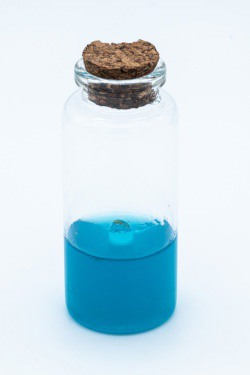 © Microhemp
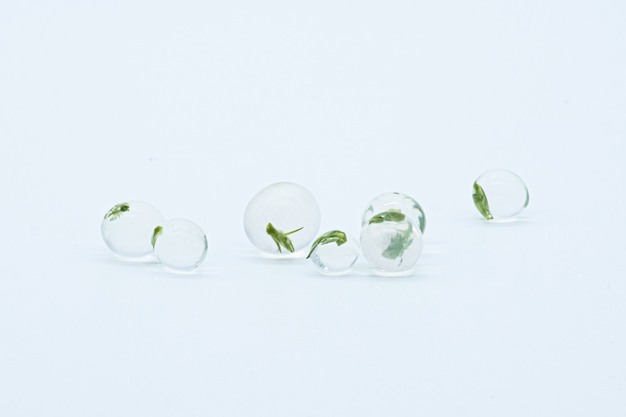
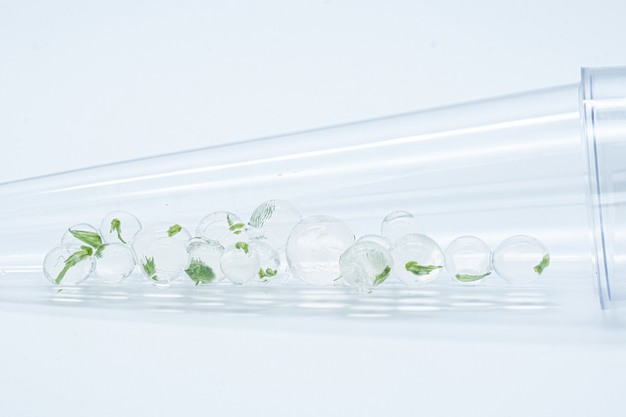
Genetic conservation of microhemp can also take the form of synthetic seeds, a striking way of preserving genetics that keeps traits intact for the long term, and has a practical advantage unrelated to biology. “It’s a very convenient option from a purely logistical point of view,” explains Marco. “If a multinational has facilities in several countries and opens a new site in North Macedonia, synthetic seeds are the best way to move a specific genetic. Put the pot in your pocket,” he laughs.
The reality is more nuanced, as Marco is quick to acknowledge. Synthetic seeds cannot yet be germinated in rockwool, a separate laboratory is required on the recipient side. Microhemp has tested a middle solution: a container format that holds the synthetic seed and the grow room in the same container, but mechanically separated. The user drops the seed in the room to initiate the roots. “It wasn’t guaranteed enough. The seed was germinating with reasonable frequency, but not good enough,” says Marco. For now, the project is on hold while the company focuses on scaling up its core micropropagation and lab design services, which, as Marco says, is what a tissue culture lab actually does.
For more information:
Microhemp Srl
Via Giuseppe Verdi 131, 41019 Soliera (MO), Italy
+393351736178
(email protected)
microhemp.it








cbdMD welcomes the Administration’s call for Congress to ensure fair treatment of hemp-derived products under federal law and calls for immediate action to revise hemp regulations to ensure fair treatment of hemp products under federal law.
In a letter to congressional leadership this week, the White House Office of Management and Budget identified hemp reform as a priority strongly supported by the Administration. The petition calls on Congress to ensure fair treatment of hemp-derived products by maintaining access to appropriate full-spectrum CBD products, and by maintaining Congress’ intent to reduce products that pose health risks. The administration also urged Congress to pass a responsible federal framework or at least extend the current implementation period to give lawmakers time to get policy right. The request builds on the president’s previous public statements urging lawmakers to protect access to full-spectrum CBD products that millions of Americans rely on.
“We are encouraged to see the administration so clearly championing the responsible, scientific hemp products that consumers depend on every day,” said Ronan Kennedy, CEO of cbdMD. “cbdMD has always believed that the future of this category is built on quality, transparency, and clear rules that separate them from bad actors. A federal framework that protects consumer access, promotes safety, and provides certainty to companies that provide certainty is what this industry and the people it serves deserve. We applaud the policymakers who are working to achieve this outcome.”
“We believe CbdMD is purpose-built for this next phase of the market,” added Kennedy. “Our focus remains on serving our customers with reliable and effective products, supporting responsible regulation and building long-term value for our shareholders as the category continues to evolve. Along the way, we will continue to evaluate the opportunities this evolving environment holds.”
For more information:
cbdMD 
cbdmd.com/
Two new RAND reports commissioned by the Richard M. Fairbanks Foundation outline the policy options and financial commitments facing Indiana as the state debates whether to change its cannabis laws amid restrictions across the country.
Reports show that 44% of Indiana residents live within 50 miles of a licensed dispensary in a neighboring state, and 96% live within 100 miles, as three of Indiana’s four states have legalized adult-use cannabis. At the same time, intoxicating hemp products containing the same psychoactive compound as marijuana are available at gas stations, convenience stores and grocery stores throughout Indiana with limited oversight.
Cannabis use in Indiana has doubled in the past decade, with a significant increase among adults 26 and older. RAND estimates that 1.3 million Hoosiers used cannabis in 2024 and spent $1.8 billion on marijuana products that year. Indiana recorded more than 13,000 cannabis-related arrests in 2024, with more than 90% for possession and more than 75% for non-cannabis related charges. The state spends $10 million to $20 million annually on cannabis law enforcement.
Rather than recommending a specific policy, the RAND reports outline four broad options: maintaining prohibition, reducing criminal penalties for possession, legalizing medical cannabis, or legalizing the adult recreational use market. Legalizing adult-use cannabis would generate about $180 million in annual state revenue, roughly 1 percent of the state’s general fund, well below some previous projections and less than half of the $385 million in combined cigarette and alcohol tax revenue Indiana will collect in 2025, according to the Indiana Department of Revenue.
Legalization would also entail significant upfront costs, and ongoing regulatory costs could reach the low tens of millions of dollars annually, outweighing the savings from reduced criminal justice spending. RAND identifies 14 policy considerations important to establishing legal markets, each with its own public health and state economic implications.

Weed Talk News Special Report & Interview Redefining Hemp Throws Industry into Turmoil

INVESTING IN CANNABIS | EMILY PAXHIA

cbdMD welcomes White House call for fair treatment of hemp-derived products

Industry Sentiment vs Reality – Could The Hemp Ban Be Extended?

Applications For Missouri Marijuana Microbusiness Licenses Will Open Next Month

Half of Gen Z Diagnosed with Depression Report Using Cannabis

Will the Farm Bill of 2024 Close Down Hemp Derived Highs? The Full A and B Blocks of Weed Talk News

Let’s Be Blunt with Montel – Algorithmic Boost Request – 2000000 #YTBoostRequest

RAND estimates Indiana adult-use cannabis could yield $180M in annual revenue

Institutions Evaluate Cannabis While Trulieve CEO Sells Shares

“Our system can manage equipment across 10,000+ m² using just a few wires”

Florida Workshop to Discuss What Constitutes a ‘Cartoon’ in Hemp Packaging

Mazar-i-Sharif Hash Wednesday

Afghan Black Hash Wednesday

Weak Michigan Cannabis Sales Again in July – New Cannabis Ventures

From Finance to Wellness: Brad Zerman’s Impactful Pivot

DEA’s Cole Reverses His “priorities” ; Prohibitionists Dig In; Dead & Co Celebrates 60 years in SF

Re-release of the full show of Cannabis Coast to Coast news. Republican Texas DA Fires Up vs. laws;

Curaleaf Q2 Revenue Falls 8% – New Cannabis Ventures

Your Cannabis Business: Consistent Filings Are Critical
-
 Cannabis News10 months ago
“Our system can manage equipment across 10,000+ m² using just a few wires”
-
 Florida11 months ago
Florida Workshop to Discuss What Constitutes a ‘Cartoon’ in Hemp Packaging
-
 Video9 months ago
Mazar-i-Sharif Hash Wednesday
-
 Video9 months ago
Afghan Black Hash Wednesday
-
 aawh11 months ago
Weak Michigan Cannabis Sales Again in July – New Cannabis Ventures
-
 Video11 months ago
From Finance to Wellness: Brad Zerman’s Impactful Pivot
-
 Video10 months ago
DEA’s Cole Reverses His “priorities” ; Prohibitionists Dig In; Dead & Co Celebrates 60 years in SF
-
 Video11 months ago
Re-release of the full show of Cannabis Coast to Coast news. Republican Texas DA Fires Up vs. laws;