
Cannabis News
Labor management system even more widely applicable after update


In the Netherlands, greenhouse growers are increasingly looking for ways to manage energy and labor costs. This was also a key theme at the recent Aardbeiendag (Strawberry Day), where Ridder presented its work management system, Ridder Productive. The system has been updated to better meet the specific needs of strawberry growers, with further updates being developed. Sales director Niels Hiemstra explained.
Ridder Productive has been on the market for over 30 years and is widely used in the greenhouse industry. According to Hiemstra, the system has traditionally been adopted by large fruit and vegetable producers. “As Ridder, we focus on those growers in the Netherlands, Belgium and North America and Mexico as well. However, the product itself is fundamentally much broader.”
 © Thijmen Tiersma | MMJDaily.comNiels Hiemstra and Arjan van der Klaauw on Strawberry Day
Adapted for strawberry cultivation
The work management system allows growers to record what tasks are done, where and when they are done and what the production is. At the request of customers, specific adjustments have been made for strawberry production, so that labor and production can be recorded more precisely.
In the early years, before the change to Ridder Productive, the system was known as P-Plus or PadPlus. It supported a work record per row. Strawberry growers, however, harvest the crop in crates that are placed in crates. Therefore, Ridder has introduced the possibility to record the activities of each box containing packaged fruit.
NFC tags or QR codes
The system uses scanners capable of reading NFC tags and QR codes. As Hiemstra explains: “In a previous version of the system, which is still widely used, growers work with fixed terminals in various places in the greenhouse. Work activities are recorded by entering the corresponding codes. This can lead to errors. When an NFC tag is reduced in a row, on a harvest trolley or in a box or box in strawberry production, it mainly reduces errors by the user. Terminal-based registration in scanners with NFC tags.”
The option to scan QR codes or barcodes also creates opportunities for traceability. QR codes could already be scanned for punnets, and this functionality has now been extended to other elements, such as rows. A QR code or barcode from an external party can also be used, allowing the scanned product to be tracked to the customer throughout the supply chain. This allows growers to see where, when and by whom a specific crate or crate was harvested.
With these adaptations, Ridder Productive has become more suitable for strawberry cultivation, which is increasingly carried out in high-tech greenhouses. As a result, cultivation has come closer to Ridder’s traditional approach. Hiemstra occasionally knows strawberry growers who don’t use labor record systems, but who are considering it as their business expands. “As they grow, they realize that more professionalization is necessary. They move from basic time recording to a more detailed and comprehensive work management system.”
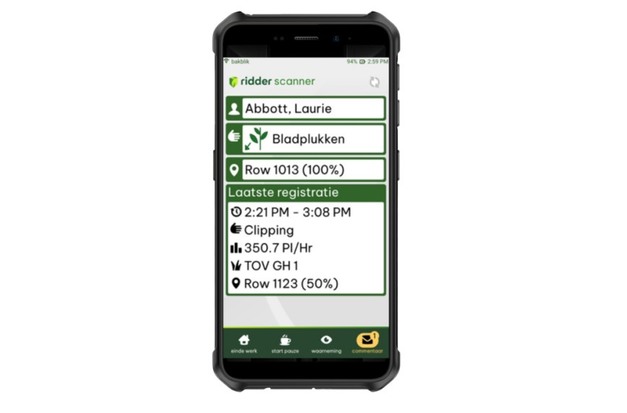 © RidderWith the Scanner app, an employee scans NFC tags or QR codes
Combining greenhouse and outdoor cultivation
In the Netherlands, Ridder has traditionally been active in high-tech greenhouses. However, Ridder Productive can also be used in open ground production, for example by strawberry growers who combine greenhouse cultivation with outdoor fields. In both situations, a detailed and accurate work record is required.
“Measuring who does what and where can be done both in the greenhouse and in field crops,” says Niels Hiemstra. “Instead of linking data to a specific row in the greenhouse, you can just as easily link it to a specific area.”
He recognizes that the labor management system is still relatively little used in outdoor cultivation. However, he hopes that may change as strawberry production continues to expand. Lettuce and herb producers, for example, combine greenhouse and outdoor production.
Outside the Netherlands, Hiemstra knows users of Ridder Productive in lettuce production. The ability to scan NFC tags or QR codes plays an important role. “When we only worked with fixed terminals, it was less practical to use in open areas, partly because of the cable requirements. Hardware was a limitation. Now that we work with scanners and can equip robust smartphones for scanning, the system has become more accessible for outdoor crops.”
In principle, ornamental producers can also use the system. However, Hiemstra points out that there is generally less demand for detailed employment records in this segment. “Often, more attention is paid to the entire production. But for companies that want to accurately measure work performance, the system can certainly be applied there as well.”
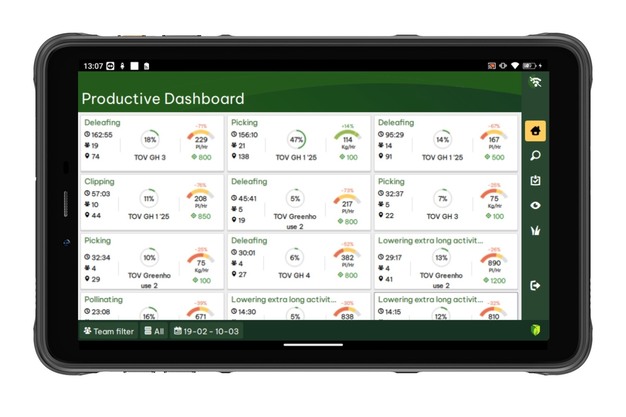 © RidderRidder also offers a manager application in Ridder Productive. There, a work manager can see the performance of the employees.
New version coming soon
Ridder Productive, which has been in the market for more than three decades, continues to evolve. According to Niels Hiemstra, continuous development is essential, especially in software. “If you get stuck in software, you quickly fall behind.”
The ’26 version is expected to be introduced this year. “It includes many small improvements that make everyday use easier. They may not all be very visible, but they make a difference in practice.”
This is on purpose, he explained. Satisfied users aren’t necessarily looking for major changes every six to twelve months. They prefer stability in features that work well and are popular. Ridder takes this into account in the upcoming update.
One area where the changes will be more noticeable is the dashboard environment. In cooperation with various manufacturers, the design and information display have been significantly improved. “We offer a standard configuration, but it is possible to create a custom panel at the request of the user with the help of our service department.”
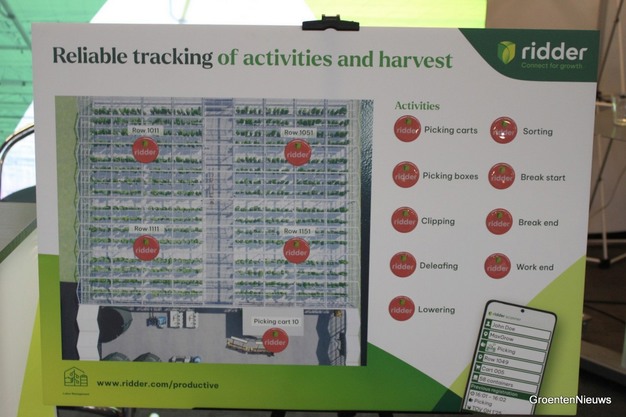 © Thijmen Tiersma | MMJDaily.com
Combining with other data sources
In addition to work management systems, many greenhouse companies know Ridder for their drive systems, Hortimax climate computers and climate monitors.
In terms of software, Ridder deliberately keeps the Ridder Productive and the Hortimax climate computer as separate systems. “Both products are part of the management of a modern greenhouse operation,” says Niels Hiemstra, “but growers can choose from us whether they want to use both systems.”
Growers who work with a different climate computer can also use Ridder Productive. According to Hiemstra, Ridder is open to creating data links with other systems upon user request. “This way, we ensure that our systems fit into the wider greenhouse ecosystem and that the grower is properly protected.”
For more information:
Niels Hiemstra
Equestrian
(email protected)
www.ridder.com/nl/arbeidsmanagement














San Jose-based family-owned cannabis dispensary, Purple Lotus, has announced the launch of Lotus NOW, a Priority Delivery Program that delivers premium cannabis from store to door in an hour or less. The program is now available at plpcsanjose.com/lotus-now and is available to adults 21 and older in more than 51 cities in Santa Clara, Alameda, San Mateo and Contra Costa counties.
Lotus NOW tackles the long wait times associated with traditional cannabis delivery. Orders placed through the program are prioritized instantly, fulfilled by Purple Lotus’ in-house drivers and supported by real-time GPS tracking and automatic SMS updates, giving customers complete transparency from payment to out the door.
“Our customers have been asking for faster shipping for years. Lotus NOW is our answer, not just faster, but a completely better experience. Live tracking, real inventory, our own drivers and the quality people Purple Lotus has trusted for 15 years,” said Matt Krishnamachari, founder of Purple Lotus.
Key features of Lotus NOW include express delivery in one hour or less, live GPS tracking, automatic text notifications, live sync inventory showing only in-stock products and flexible payment by debit card, cash or Treez Pay. All deliveries are handled by Purple Lotus trained staff only, with no third party courier services. Customers receive an SMS confirmation immediately after ordering, followed by additional updates when the order ships, the driver is on the way, and upon arrival.
The Lotus NOW catalog covers the full range of cannabis categories available in California, with live inventory updates that show only what’s currently in stock, eliminating the common frustration of placing an order only to find out items are unavailable. Lotus NOW currently ships to more than 51 Bay Area cities, including San Jose, Santa Clara, Sunnyvale, Mountain View, Palo Alto, Cupertino, Milpitas, Campbell, Los Gatos and Saratoga, as the flagship service of the San Jose express delivery program.
New customers can start using Lotus NOW by visiting plpcsanjose.com/lotus-now, performing a one-time age and identity verification and placing an order from any address in the service area. Existing Purple Lotus customers can choose Lotus NOW directly from their account dashboard with no additional setup required. The program operates during all hours of licensed delivery of California cannabis, seven days a week, with availability throughout the priority routing window.
For more information:
The purple lotus
https://plpcsanjose.com/

Curaleaf Holdings has completed the acquisition of the remaining 45% stake it did not previously own in Four 20 Pharma GmbH, a German producer and distributor of fully EU-GMP and GDP licensed medical cannabis. Four 20 Pharma is recognized for its high quality cultivation, pharmaceutical grade processing and comprehensive distribution network in Germany and several European markets serving nursing homes, pharmacies and research institutions. The company’s commitment to compliance, patient care and scientific rigor positions it as a cornerstone of the European medical cannabis ecosystem.
The full acquisition of Four 20 Pharma vertically strengthens Curaleaf’s integrated global supply chain, from proprietary cultivation sources in Portugal and Canada to licensed distribution throughout Germany, providing patient quality assurance from seed and full oversight at every stage. Since the initial agreement in 2022, Curaleaf and Four 20 Pharma have worked closely together to expand patient access, advance research initiatives and streamline the international cannabis supply chain by validating a data-driven approach to education, cultivation and product development.
 © Curaleaf
“Completing this acquisition of the remaining stake in Four 20 Pharma reinforces our commitment to Europe and the strategic importance of building high-quality local operations in a market that will continue to grow significantly,” said Boris Jordan, CEO and President of Curaleaf. “Four 20 Pharma’s leadership in production, fulfillment and distribution allows us to expand patient access to medical cannabis while driving innovation in the international market. This investment has been a significant and strategic anchor in our international strategy, and we look forward to continued long-term growth in Europe.”
“Joining Curaleaf as a fully integrated subsidiary marks an exciting new chapter for Four 20 Pharma,” said Torsten Greif, Founder and Managing Director of Four 20 Pharma. “We built this company on an uncompromising commitment to quality, compliance and patient care, values that align perfectly with Curaleaf’s international mission. Together, we are positioned to set the standard for medical cannabis in regulated markets around the world.”
Building on the success of Four 20 Pharma in Germany, Curaleaf has already launched the Four 20 brand in the UK and Poland and plans to continue expanding the brand to additional international markets, leveraging the quality and fulfillment model that has made Four 20 Pharma one of Germany’s most trusted medical cannabis brands.
For more information:
Curaleaf
(email protected)
curaleaf.com
Cannabis News
West Virginia Supreme Court Considers Whether Smell Of Marijuana Can Be Basis For Police To Search Homes


Marijuana Retail Report

New 1-hour express cannabis delivery service launches in San Jose

Report: Indiana Residents Spend About $2B on Cannabis Annually Despite Prohibition

Easy Grow Spannabis 2022

Live with Jimmy Young | September 3rd 2024 3:50PM EST

🌱Soil and Nutrient Tips for Maximum Yield

WEEDIATRICS | ERIN O’HEARN [medical cannabis documentary]

Marijuana Retail Report

Curaleaf completes buyout of remaining stake in Germany’s Four 20 Pharma

West Virginia Supreme Court Considers Whether Smell Of Marijuana Can Be Basis For Police To Search Homes

“Our system can manage equipment across 10,000+ m² using just a few wires”

Florida Workshop to Discuss What Constitutes a ‘Cartoon’ in Hemp Packaging

Mazar-i-Sharif Hash Wednesday

Re-release of the full show of Cannabis Coast to Coast news. Republican Texas DA Fires Up vs. laws;

From Finance to Wellness: Brad Zerman’s Impactful Pivot

Afghan Black Hash Wednesday

Weak Michigan Cannabis Sales Again in July – New Cannabis Ventures

DEA’s Cole Reverses His “priorities” ; Prohibitionists Dig In; Dead & Co Celebrates 60 years in SF

Your Cannabis Business: Consistent Filings Are Critical

Texas DA Partakes on Tik Tok to prove a point; Boston Sheriff arrested for Extortion of $ w/ Ascend
-
 Cannabis News8 months ago
“Our system can manage equipment across 10,000+ m² using just a few wires”
-
 Florida9 months ago
Florida Workshop to Discuss What Constitutes a ‘Cartoon’ in Hemp Packaging
-
 Video7 months ago
Mazar-i-Sharif Hash Wednesday
-
 Video9 months ago
Re-release of the full show of Cannabis Coast to Coast news. Republican Texas DA Fires Up vs. laws;
-
 Video9 months ago
From Finance to Wellness: Brad Zerman’s Impactful Pivot
-
 Video7 months ago
Afghan Black Hash Wednesday
-
 aawh9 months ago
Weak Michigan Cannabis Sales Again in July – New Cannabis Ventures
-
 Video8 months ago
DEA’s Cole Reverses His “priorities” ; Prohibitionists Dig In; Dead & Co Celebrates 60 years in SF