Connect with us

Cannabis News

Trump’s New Surgeon General Pick Said Using Marijuana Can Give You ‘Man Boobs’

Published

on

President Donald Trump’s new surgeon general nominee has raised concerns about marijuana, at one point saying its use is linked to the development of large breasts, or “man boobs,” in men. However, he also admitted that medical cannabis has “potential benefits”.

Trump announced Thursday that he would tap Nicole Saphier, who is now the director of breast imaging at Memorial Sloan Kettering, to be the surgeon general of the United States.

Saphier has repeatedly discussed what he sees as the dangers of marijuana use, and has been more open to the potential benefits of its non-intoxicating ingredient CBD.

“There is a common misconception that marijuana is safer than alcohol and other drugs,” he wrote on Fox News in 2019. “As a doctor I know that marijuana is not harmless and can have serious adverse effects on the health of users.”

“And as a mother of three (one in college), I’m concerned that legalizing the drug for adults sends a clear message to kids that they can get pot without negative health effects,” she said.

Saphier went on to criticize the 2020 Democratic presidential candidates who supported marijuana reform, saying it’s “politically a popular cause, especially among young voters.”

“These candidates are more interested in how legalization of pot will affect their electoral prospects than how legalization will affect public health,” he said. he wrote.

Among the health concerns he has raised is that cannabis use is “directly linked” to “man boobs”.

“Physically, we know that marijuana is directly linked to respiratory problems (if smoked), cardiovascular disease, and gynecomastia (“man nipples”). As a breast radiologist, the first question I ask men when they come in for breast augmentation is whether they currently smoke marijuana or have smoked it in the past. Often, the answer is “yes.”

Trump’s appointment of Saphier comes just as his administration is moving forward with federal rescheduling of marijuana.

Although the surgeon general has no formal involvement in the drug program, which is administered by the Department of Justice and the Department of Health and Human Services, the position is seen as “America’s doctor” and plays a role in addressing health issues on behalf of the government.

In a podcast earlier this year, Saphier admitted that there are “potential benefits” to medical cannabis.

“Of course, there is evidence supporting cannabinoids for chemotherapy-induced nausea, certain seizure disorders, chronic pain syndromes, multiple sclerosis,” he said. “But that’s very different than, you know, the general normalization of high-potency recreational cannabis on a daily basis, especially in developing brains, which doesn’t happen until age 25.”

In the same podcast, he said that he personally “doesn’t like” and has “never tried” cannabis.

“I think CBD products are probably significantly less harmful if they don’t have THC. I’m not a fan of THC,” Saphier. he said. “I think if people are trying to get away from alcohol and want to take low doses of CBD, not inhale it, not smoke it, I’m sure it’s probably less risky than some of the other things out there.”

“Let’s be honest, today’s cannabis is not your parents’ marijuana. The potency of THC has increased dramatically over the last two decades. High-concentrate products, vapes, dabs, edibles, what the kids are doing these days, I don’t even know.”

In another interview focused on concerns about cannabis use by pregnant women, Saphier he said “As we continue to legalize marijuana, people are equating that to, ‘it has to be safe.'”

In a separate interview, he suggested that the legalization of cannabis is increasing its use among young people, which he said increases rates of addiction and psychosis.

“One in six children who try it, becomes addicted. Cannabis use in children, the risk of psychosis is four times higher,” he said. “What have we done? Legalize. Normalize.”

Trump’s predecessor, now retired Candidate Casey Means discussed his “significant experiences” with psychedelics beforehand Saying that marijuana “can greatly decrease your ability to generate good energy.”

Means himself said during a confirmation hearing in February he would not advise Americans to experiment with psychedelics as he has donebut noted that there is “exciting” research indicating that substances such as psilocybin can effectively treat serious mental health conditions.

Marijuana Moment is made possible with the help of readers. If you rely on our pro-cannabis journalism to stay informed, consider a monthly Patreon pledge.

Cannabis News

Good Behavior dispensary applies to open in Yorkville

Published

on

By


A cannabis company called Good Behavior is seeking approval from the city of Yorkville, Illinois, to open a dispensary on a 0.93-acre plot along Saravanos Drive, west of South Bridge Street and south of Stagecoach Trail, becoming the latest entrant in a string of cannabis proposals the city has previously rejected. The company has filed a special-use application with the city and is staking its case on the tax revenue a dispensary would generate for Yorkville.

Full details of the application, including projected tax figures, the company’s ownership structure and details of any board discussions, are available to Shaw Local News Network subscribers. The article, reported by Shaw Local News Network’s Joey Weslo and published on June 23, 2026, notes that cannabis companies had previously failed to get city approval before Good Behavior presented its proposal.

The proposed site places the dispensary in a commercial corridor to the south of the city. Good Behavior’s application requires a special use permit from Yorkville before the project can proceed.

Source: local Shaw


Continue Reading

Cannabis News

White House Pushes Congress To Ensure ‘Fair Treatment Of Hemp Products’ By Calling Off Broad Recriminalization Law Set For November

Published

on

By

The White House is pressing Congress to take action to prevent the sweeping federal recriminalization of hemp products that will take effect later this year.

The push comes as part of a request to lawmakers for additional funding to help the administration cover costs related to attacks on Iran and “other critical needs,” such as responding to an Ebola outbreak in Africa.

“Furthermore, the Administration is seeking additional authorities that it strongly supports,” White House Office of Management and Budget Director Russell Vought wrote to House Speaker Mike Johnson (R-LA) on Wednesday.

“These authorities include a review of federal hemp regulations to ensure fair treatment of hemp products consistent with Amendment 54 offered to HR 8646 in the House Rules Committee, or at least an extension of the implementation of the regulatory framework established by Section 781 of Public Law 119-37,” he said.

The amendment Vought was referring to was introduced by Rep. Andy Barr (R-KY). It has kept many hemp products legal that will be re-criminalized this yearadded labeling requirements and implemented new sales taxes, among other regulatory reforms. However, the Rules Committee prevented it from receiving a House vote.

Barr is also preparing to introduce stand-alone legislation on the issue and has said she opposes a coalition of strange bedfellows. the alcohol industry, marijuana businesses and opponents of cannabis legalization.

An appendix to the White House’s letter to Congress this week notes that the hemp-related request would “update the statutory definition of hemp-derived cannabinoid end products to ensure Americans have access to appropriate full-spectrum CBD products while maintaining Congress’ intent to limit the sale of products that pose serious health risks.”

The the administration used hemp-like language Earlier this month, they blocked retention of Barr’s previous amendment to the administration’s policy statement on the farm funding bill.

Jonathan Miller, general counsel of the US Hemp Desk, told Marijuana Moment that the group is “pleased to see the president take a public stance in favor of replacing the hemp ban with a strong regulatory framework, or at least securing an extension of the hemp ban moratorium to give Congress more time to develop regulations.”

“This is an important step in fulfilling Congress’ commitment to help farmers and consumers,” he said.

Hemp derivatives with less than 0.3 percent delta-9 THC by dry weight were made federally legal under the 2018 Farm Bill signed by Trump during his first term. But late last year, he signed new legislation with provisions that will redefine hemp, so that only products with a total of 0.4 milligrams of THC per container will remain legal starting November 12.

in April, the president himself has asked members of Congress to redefine hemp to prevent the recriminalization of full-spectrum CBD products.

“I call on Congress to update the Act so that Americans can continue to have access to the full-spectrum CBD products they trust and support, while upholding Congress’ intent to limit the sale of products that pose health risks,” Trump said in a Truth Social post the same day his administration announced it was moving forward with marijuana reregulation.

“We need to do this RIGHT and FAST, especially for those who have found CBD to help them,” he said. “Also, I’m told it will help our BIG FARMERS that we love and will always be around.”

Industry advocates say the law passed last year not only threatens to ban intoxicating and synthetic cannabinoids, but also take popular full-spectrum CBD products used therapeutically by many Americans off the market.

“ONE IN FIVE adults used it in the past year, and many say it dramatically improved their chronic pain,” the president said in the social media post, adding that hemp-derived CBD “has made a HUGE difference for so many people.”

The administration also referred to a new initiative launched in April Cover up to $500 of hemp-derived products annually for eligible Medicare patients. The program being implemented by the Centers for Medicare and Medicaid Services (CMS) focuses largely on CBD, but allows products to contain a total of 3 milligrams of THC per serving.

“In December, I signed a very important Executive Order calling for Research and Innovation into Hemp-derived CBD,” Trump said. “Our wonderful Dr. Mehmet Oz moved quickly to follow the Executive Order directive, and set a model in motion for some Seniors this month. But more needs to be done!”

“Please do it, and SOON,” the president said, referring to the sweeping recriminalization congressional fix that will take effect in November. “Thank you for your attention to this matter!”

It’s unclear how far Trump wants to reduce the scope of planned federal restrictions on hemp products and what kinds of revised THC rules and limits he’d prefer to sign into law.

Separately, White House officials recently briefed a congressional office on hemp regulation.

In April, Vince Haley, director of the White House Domestic Policy Council, and James Braid, assistant to the president for legislative affairs, sent Barr hemp policy suggestions.

“We appreciate your work to advance policy,” the executive order Trump signed in December, which included provisions to protect Americans’ access to CBD products, the staff wrote in a letter to Congress.

“We are submitting draft legislation and comments to your account to address the final statutory definition of hemp-derived cannabinoid products to ensure that Americans have access to adequate full-spectrum CBD products while maintaining Congress’ intent to limit the sale of products that pose serious health risks,” White House officials said, according to a social media screencast. “We are open to discussion and further technical assistance.”

Separately, Anti-marijuana organizations filed a lawsuit against the Medicare hemp CBD coverage policy– but adjudge dismissed the suit last month, ruling they lack standing. Health and Human Services lawyers section. Robert F. Kennedy Jr. and CMS director Mehmet Oz He filed a letter requesting that the case be dismissed.

The White House Management and Budget Office has also held a series of meetings a Food and Drug Administration (FDA) CBD product enforcement policy.

The FDA issued the guidance making it clear that it does not intend to interfere Establish a Medicare coverage plan for hemp-derived products.

CMS finalized a rule that will be adopted separately Coverage of certain hemp products, primarily as specialized health-related benefits, through Medicare Advantage the plans

As hemp products become more popular among consumers, some big brands are trying to get in on the action.

The main retailer Target, for example, is expanding its market share of hemp-derived THC beverages. Last year, the company began a pilot program selling cannabis beverages at 10 stores in Minnesota. That apparently went well, and now the company has secured licenses from Minnesota regulators to sell lower-potency edible hemp products — including THC drinks — in 72 stores in the state.

The National Restaurant Association, which represents the industry, just sent a letter to congressional leaders asking for it delaying the federal recriminalization of hemp THC beverages It will come into effect at the end of the year and will be replaced by a regulatory framework that “meets growing market demand while ensuring consumer safety” as an alternative to alcohol in products.

A report from the US Department of Agriculture published in April shows this US farmers grow $3 billion in hemp crops by 2025— 64% increase compared to the previous year.

Read the White House the letter To the conference below:

Marihuana Moment is made possible with the help of readers. If you rely on our pro-cannabis journalism to stay informed, consider a monthly Patreon pledge.

Continue Reading

Cannabis News

Guido de Buijn (Agrofair) consolidates his leading position, whilst fruit and vegetable lawyer Hans Borsboom enters the top five
Published

on

By


FreshPublishers 2026 World Cup Group Stage


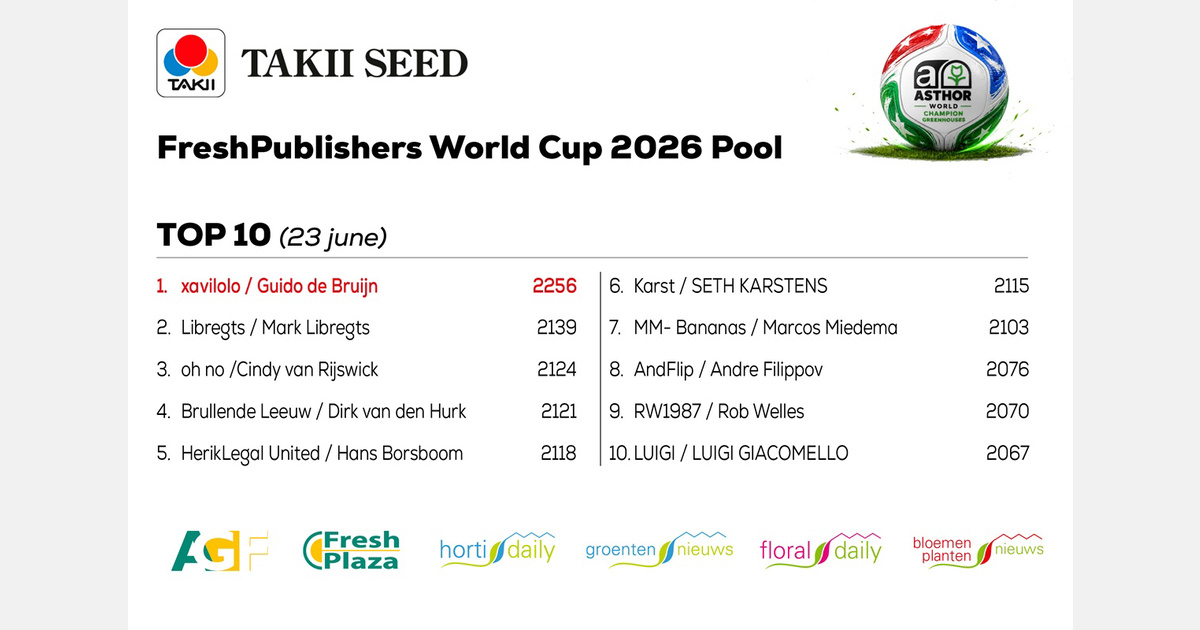
Today, it is the Dutch who are making their mark in the Fresh Publishers’ World Cup rankings. Guido de Bruijn, Agrofair’s account manager, correctly predicted the results of the Argentina – Austria and France – Iraq matches, thus consolidating his leadership. He is followed by quality controller Mark Libregts of JNV Produce, while food and agriculture specialist Cindy van Rijswick of Rabobank has once again rounded out the top three. In fourth place is Dirk van den Hurk, aaff’s relationship manager. He has a three-point lead over fruit and vegetable lawyer Hans Borsboom, who is competing under the name HerikLegal United. Interestingly, the main contestants predict very different winners. Guido supports Portugal, Mark supports France, Cindy supports Germany and Dirk and Hans support Spain.

In sixth place is Seth Karstens, who manages retail sales for Gerbera United. Marcos Miedema – again from Agrofair – is seventh, ahead of Andre Filippov from the German company Global Fruit Point. Rob Welles of plant grower Ovata and Italian potato and vegetable trader Luigi Giacomello have slipped a little further up the table and are in ninth and tenth place. However, there is still a long way to go to win the 1,000 euros. Starting with the next four matches: Portugal – Uzbekistan, England – Ghana, Panama – Croatia and Colombia – Congo.

© FreshPublishers


Publication date:


Continue Reading
Advertisement

Trending

Copyright © 2021 The Art of MaryJane Media