Connect with us

Cannabis News

West Virginia Supreme Court Considers Whether Smell Of Marijuana Can Be Basis For Police To Search Homes

Published

on

“There is no longer an inherent connection or logical connection between the smell of marijuana and illegal activity, and for good reason.”

By Lori Kersey, West Virginia Watch

The West Virginia Supreme Court of Appeals is considering a case that questions whether the smell of marijuana alone is enough for law enforcement to obtain a warrant to search a person’s home.

The Supreme Court is expected to rule on an appeal of the Berkeley County Circuit Court’s decision to throw out evidence found in a home after Martinsburg police detected a “strong odor” of drugs. Ignoring the evidence prevented the state from prosecuting a man on drug charges, a lawyer told judges last week.

Aaron Lewis was arrested in 2020 on three counts of drug possession with intent to deliver and being a prohibited person in possession of a firearm, according to to report From the Herald-Mail.

Court documents say Martinsburg police were responding to a call from another man, who was searching the caller’s yard, about a suicidal woman who allegedly stabbed herself. The officers were unable to find the woman and began a door-to-door search for her.

Officers went to Lewis’ home where his son, Aaron Lewis Jr., answered the door. Officers detected a “strong odor of marijuana,” according to court documents. Young Lewis refused to give officers permission to search the house.

Before obtaining a search warrant, they entered the home to conduct a “protective search,” during which they found a wad of cash and two clear containers in the kitchen’s kitchen, court documents say. Two officers then left to obtain a search warrant while other officers remained on scene to secure the apartment.

An officer cited the strong odor of marijuana and observations during the sweep as the basis for believing a controlled dangerous substance was present in the home.

A magistrate granted a warrant to search Lewis’ home, seizing “(a)ny and all controlled substances … including, but not limited to, heroin and methamphetamine,” as well as seizing cash, firearms, books, digital devices and drug paraphernalia. the documents say

During the search, officers seized bags and containers of suspected marijuana, a bag of suspected heroin, a bag of crack cocaine, a handgun and 11 rounds of ammunition and cash, according to court documents.

A lawyer for Lewis asked a judge in 2023 to suppress all evidence seized under the warrant, arguing that the initial warrantless search — a security search before a search — violated the Fourth Amendment, which protects against unreasonable searches and seizures. Without the observations made during the search, all that was left was the smell of marijuana, and that alone is not enough to constitute probable cause, the attorney argued.

Berkeley Circuit Judge Debra McLaughlin granted Lewis’ motion to suppress the evidence, saying homes searched should be given more protection than cars. The judge ruled that the smell of marijuana alone did not constitute evidence of “illegal drug trafficking and/or possession of heroin, methamphetamine and/or other illegal drugs” in the home, court documents state.

The state of West Virginia is seeking a writ of prohibition in the case, a legal order barring the circuit court from proceeding outside its jurisdiction.

“The precedent for this court is clear,” Holly Mestemacher, West Virginia’s assistant attorney general, told the justices. “The odor of marijuana provides probable cause to search. The circuit court ignored and rewrote the law and suppressed evidence seized pursuant to a search warrant.” He described the judge’s decision to suppress the evidence as a “clear and glaring legal error” that exceeded his authority.

The court required “an almost impossible list of proofs required before certainty and probable cause exist,” he argued.

The ruling took away evidence the state needed to move forward in the case, he said.

“It’s actually a death knell for our ability to judge because the court required that standard far beyond what the law has ever required,” he said.

Cameron LeFevre, an attorney representing Lewis, asked the Supreme Court to uphold the Circuit Court’s ruling denying the state’s request for a writ of prohibition. He said the judge doesn’t have to answer whether the smell of marijuana justifies a search. There were “flaws” in the case, he said, including an improper security search, an illegal search of the home and an affidavit that lacked important details.

Federal courts have affirmed that the smell of marijuana is evidence of criminal activity and warrants law enforcement, but many state courts are reconsidering that based on the changing legal status of the drug. according to State Court Report, A project of the Brennan Center for Justice at NYU Law School. The West Virginia Legislature legalized medical marijuana in 2017. All states around West Virginia have legalized medical or recreational marijuana.

LeFevre argued that the Lewis case is not appropriate for the Supreme Court to decide whether the smell of marijuana alone is sufficient to warrant a lawful search.

“There’s an incomplete record. It’s a unique procedural stance. It’s in a writ of prohibition,” he said. “It would be far better for the court to reasonably decide . . . the case on its final merits, after a trial, after a full record, and then there are no other procedural and legal issues in the process of seeking the warrant and the search itself.”

However, if the court decides to take up the issue of the smell of marijuana, he said, the mere smell of marijuana is no longer sufficient probable cause.

“There has been an important development in the laws of the land regarding marijuana,” he said. “(Medical marijuana) has been legalized in West Virginia. It’s been partially legalized in other states around West Virginia. There’s no longer an inherent connection or logical connection between the smell of marijuana and illegal activity, and there’s good reason for that.”

The court is expected to rule on the case before the end of the current trial on June 11.

This story was first published by West Virginia Watch.

Marijuana Moment is made possible with the help of readers. If you rely on our pro-cannabis journalism to stay informed, consider a monthly Patreon pledge.

Continue Reading

Cannabis News

Good Behavior dispensary applies to open in Yorkville

Published

on

By


A cannabis company called Good Behavior is seeking approval from the city of Yorkville, Illinois, to open a dispensary on a 0.93-acre plot along Saravanos Drive, west of South Bridge Street and south of Stagecoach Trail, becoming the latest entrant in a string of cannabis proposals the city has previously rejected. The company has filed a special-use application with the city and is staking its case on the tax revenue a dispensary would generate for Yorkville.

Full details of the application, including projected tax figures, the company’s ownership structure and details of any board discussions, are available to Shaw Local News Network subscribers. The article, reported by Shaw Local News Network’s Joey Weslo and published on June 23, 2026, notes that cannabis companies had previously failed to get city approval before Good Behavior presented its proposal.

The proposed site places the dispensary in a commercial corridor to the south of the city. Good Behavior’s application requires a special use permit from Yorkville before the project can proceed.

Source: local Shaw


Continue Reading

Cannabis News

White House Pushes Congress To Ensure ‘Fair Treatment Of Hemp Products’ By Calling Off Broad Recriminalization Law Set For November

Published

on

By

The White House is pressing Congress to take action to prevent the sweeping federal recriminalization of hemp products that will take effect later this year.

The push comes as part of a request to lawmakers for additional funding to help the administration cover costs related to attacks on Iran and “other critical needs,” such as responding to an Ebola outbreak in Africa.

“Furthermore, the Administration is seeking additional authorities that it strongly supports,” White House Office of Management and Budget Director Russell Vought wrote to House Speaker Mike Johnson (R-LA) on Wednesday.

“These authorities include a review of federal hemp regulations to ensure fair treatment of hemp products consistent with Amendment 54 offered to HR 8646 in the House Rules Committee, or at least an extension of the implementation of the regulatory framework established by Section 781 of Public Law 119-37,” he said.

The amendment Vought was referring to was introduced by Rep. Andy Barr (R-KY). It has kept many hemp products legal that will be re-criminalized this yearadded labeling requirements and implemented new sales taxes, among other regulatory reforms. However, the Rules Committee prevented it from receiving a House vote.

Barr is also preparing to introduce stand-alone legislation on the issue and has said she opposes a coalition of strange bedfellows. the alcohol industry, marijuana businesses and opponents of cannabis legalization.

An appendix to the White House’s letter to Congress this week notes that the hemp-related request would “update the statutory definition of hemp-derived cannabinoid end products to ensure Americans have access to appropriate full-spectrum CBD products while maintaining Congress’ intent to limit the sale of products that pose serious health risks.”

The the administration used hemp-like language Earlier this month, they blocked retention of Barr’s previous amendment to the administration’s policy statement on the farm funding bill.

Jonathan Miller, general counsel of the US Hemp Desk, told Marijuana Moment that the group is “pleased to see the president take a public stance in favor of replacing the hemp ban with a strong regulatory framework, or at least securing an extension of the hemp ban moratorium to give Congress more time to develop regulations.”

“This is an important step in fulfilling Congress’ commitment to help farmers and consumers,” he said.

Hemp derivatives with less than 0.3 percent delta-9 THC by dry weight were made federally legal under the 2018 Farm Bill signed by Trump during his first term. But late last year, he signed new legislation with provisions that will redefine hemp, so that only products with a total of 0.4 milligrams of THC per container will remain legal starting November 12.

in April, the president himself has asked members of Congress to redefine hemp to prevent the recriminalization of full-spectrum CBD products.

“I call on Congress to update the Act so that Americans can continue to have access to the full-spectrum CBD products they trust and support, while upholding Congress’ intent to limit the sale of products that pose health risks,” Trump said in a Truth Social post the same day his administration announced it was moving forward with marijuana reregulation.

“We need to do this RIGHT and FAST, especially for those who have found CBD to help them,” he said. “Also, I’m told it will help our BIG FARMERS that we love and will always be around.”

Industry advocates say the law passed last year not only threatens to ban intoxicating and synthetic cannabinoids, but also take popular full-spectrum CBD products used therapeutically by many Americans off the market.

“ONE IN FIVE adults used it in the past year, and many say it dramatically improved their chronic pain,” the president said in the social media post, adding that hemp-derived CBD “has made a HUGE difference for so many people.”

The administration also referred to a new initiative launched in April Cover up to $500 of hemp-derived products annually for eligible Medicare patients. The program being implemented by the Centers for Medicare and Medicaid Services (CMS) focuses largely on CBD, but allows products to contain a total of 3 milligrams of THC per serving.

“In December, I signed a very important Executive Order calling for Research and Innovation into Hemp-derived CBD,” Trump said. “Our wonderful Dr. Mehmet Oz moved quickly to follow the Executive Order directive, and set a model in motion for some Seniors this month. But more needs to be done!”

“Please do it, and SOON,” the president said, referring to the sweeping recriminalization congressional fix that will take effect in November. “Thank you for your attention to this matter!”

It’s unclear how far Trump wants to reduce the scope of planned federal restrictions on hemp products and what kinds of revised THC rules and limits he’d prefer to sign into law.

Separately, White House officials recently briefed a congressional office on hemp regulation.

In April, Vince Haley, director of the White House Domestic Policy Council, and James Braid, assistant to the president for legislative affairs, sent Barr hemp policy suggestions.

“We appreciate your work to advance policy,” the executive order Trump signed in December, which included provisions to protect Americans’ access to CBD products, the staff wrote in a letter to Congress.

“We are submitting draft legislation and comments to your account to address the final statutory definition of hemp-derived cannabinoid products to ensure that Americans have access to adequate full-spectrum CBD products while maintaining Congress’ intent to limit the sale of products that pose serious health risks,” White House officials said, according to a social media screencast. “We are open to discussion and further technical assistance.”

Separately, Anti-marijuana organizations filed a lawsuit against the Medicare hemp CBD coverage policy– but adjudge dismissed the suit last month, ruling they lack standing. Health and Human Services lawyers section. Robert F. Kennedy Jr. and CMS director Mehmet Oz He filed a letter requesting that the case be dismissed.

The White House Management and Budget Office has also held a series of meetings a Food and Drug Administration (FDA) CBD product enforcement policy.

The FDA issued the guidance making it clear that it does not intend to interfere Establish a Medicare coverage plan for hemp-derived products.

CMS finalized a rule that will be adopted separately Coverage of certain hemp products, primarily as specialized health-related benefits, through Medicare Advantage the plans

As hemp products become more popular among consumers, some big brands are trying to get in on the action.

The main retailer Target, for example, is expanding its market share of hemp-derived THC beverages. Last year, the company began a pilot program selling cannabis beverages at 10 stores in Minnesota. That apparently went well, and now the company has secured licenses from Minnesota regulators to sell lower-potency edible hemp products — including THC drinks — in 72 stores in the state.

The National Restaurant Association, which represents the industry, just sent a letter to congressional leaders asking for it delaying the federal recriminalization of hemp THC beverages It will come into effect at the end of the year and will be replaced by a regulatory framework that “meets growing market demand while ensuring consumer safety” as an alternative to alcohol in products.

A report from the US Department of Agriculture published in April shows this US farmers grow $3 billion in hemp crops by 2025— 64% increase compared to the previous year.

Read the White House the letter To the conference below:

Marihuana Moment is made possible with the help of readers. If you rely on our pro-cannabis journalism to stay informed, consider a monthly Patreon pledge.

Continue Reading

Cannabis News

Guido de Buijn (Agrofair) consolidates his leading position, whilst fruit and vegetable lawyer Hans Borsboom enters the top five
Published

on

By


FreshPublishers 2026 World Cup Group Stage


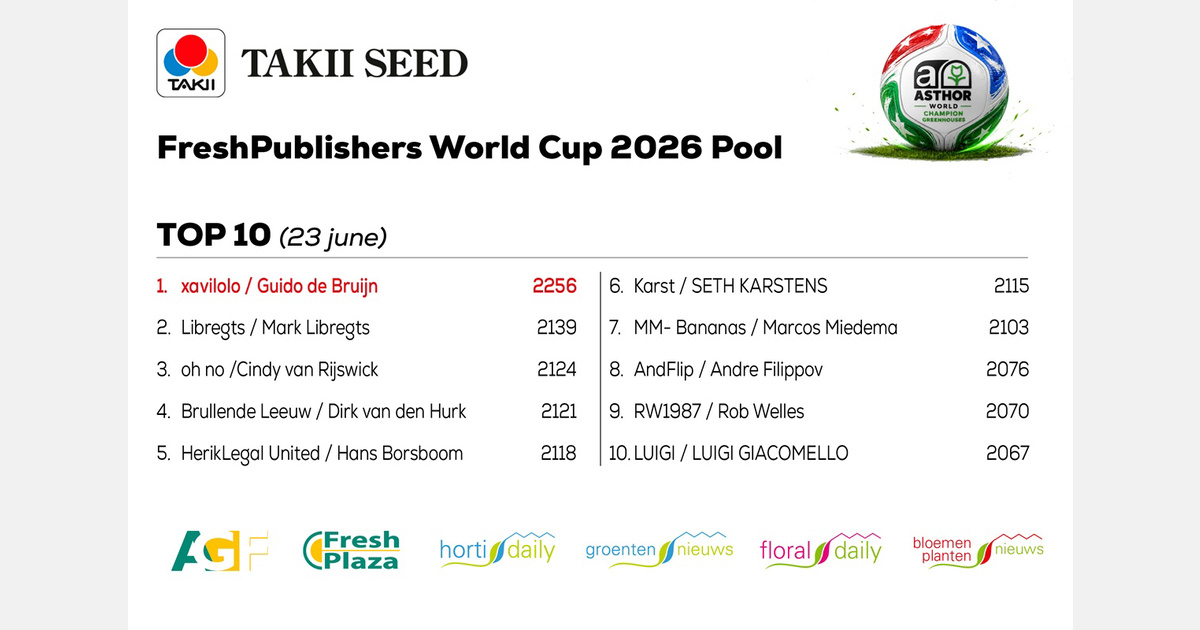
Today, it is the Dutch who are making their mark in the Fresh Publishers’ World Cup rankings. Guido de Bruijn, Agrofair’s account manager, correctly predicted the results of the Argentina – Austria and France – Iraq matches, thus consolidating his leadership. He is followed by quality controller Mark Libregts of JNV Produce, while food and agriculture specialist Cindy van Rijswick of Rabobank has once again rounded out the top three. In fourth place is Dirk van den Hurk, aaff’s relationship manager. He has a three-point lead over fruit and vegetable lawyer Hans Borsboom, who is competing under the name HerikLegal United. Interestingly, the main contestants predict very different winners. Guido supports Portugal, Mark supports France, Cindy supports Germany and Dirk and Hans support Spain.

In sixth place is Seth Karstens, who manages retail sales for Gerbera United. Marcos Miedema – again from Agrofair – is seventh, ahead of Andre Filippov from the German company Global Fruit Point. Rob Welles of plant grower Ovata and Italian potato and vegetable trader Luigi Giacomello have slipped a little further up the table and are in ninth and tenth place. However, there is still a long way to go to win the 1,000 euros. Starting with the next four matches: Portugal – Uzbekistan, England – Ghana, Panama – Croatia and Colombia – Congo.

© FreshPublishers


Publication date:


Continue Reading
Advertisement

Trending

Copyright © 2021 The Art of MaryJane Media