
Cannabis News
New York Officials Tout $2.5 Billion In Marijuana Sales, Expansion Of Licensed Businesses And More Since Adult-Use Legalization


New York officials have released a series of reports that provide a year-end status update on the state’s medical and adult marijuana markets: sales records, state coffers revenue, license approvals, equity initiatives and more.
All told, retail cannabis sales in New York have topped $2.5 billion since recreational legalization was passed, including $1.6 billion generated since November of last year alone. In addition, licensed showrooms almost doubled from 261 in 2024 to 556 in 2025..
The Office of Cannabis Management (OCM) said the state “continues to exceed” equity goals, particularly with 55 percent of adult use licenses held by Social and Economic Equity (SEE) businesses. Of these, 50 percent are minorities and 47 percent are women.
The reports also touch on enforcement action to mitigate the illegal market. And last year, OCM said it “conducted 2,017 enforcement actions that resulted in the seizure of more than $20 million worth of illegal cannabis products.”
“New York’s cannabis framework was designed to combine strong regulation with meaningful choice, and this year’s Annual Report demonstrates continued progress toward that goal,” said Jessica Garcia, Chair of the Cannabis Control Board (CCB), in a press release. “As the legal market expands, we continue to build an inclusive industry and ensure the benefits of legalization are shared broadly.”
“The launch of initiatives like Community Reinvestment Grants and the CAURD Grant Fund marks a critical step in returning resources to communities disproportionately impacted by the ban while maintaining safeguards that protect consumers and support compliant businesses,” he said.
The OCM annual report also states that Gov. Kathy Hochul (D) signed legislation expanding the state’s medical cannabis program improving patient access and “updating the program framework to better meet the needs of patients across the state.”
The legislation signed by the governor grants reciprocity to out-of-state residents, streamlines the patient certification process and allows adults 18 and older to grow their own cannabis plants for therapeutic use.
“Looking forward, we remain committed to fulfilling MRTA’s vision through licensing, regulatory reform and the support of social equity applicants,” Garcia said in the report. “We have new types of licenses to issue that will provide additional economic opportunities for New Yorkers.”
“We must improve patient access to the medical program and maintain our commitment to work on this in 2026. We will work with OCM to continue to strengthen our enforcement efforts against the illicit market,” he said. “Finally, we invest in building trust with our stakeholders and the public and aim to strengthen our communications and public engagement efforts, especially as they inform our decision-making process.”
Officials too he stated The state has taken in nearly $341 million in marijuana taxes from medical and adult-use sales from April 1, 2023, to November 30, 2025.
“Sales continue to be concentrated in a limited number of high-performing locations,” he says. “On November 30, 2025, the top 10 stores account for 29 percent of statewide sales, the top 25 for 43 percent and the top 50 for nearly 61 percent. The top 50 percent of all operating stores generate about 80 percent of total sales, reflecting advantages of location, brand presence and operational scale.”
Notably, the report bolsters advocates’ argument that regulating, rather than criminalizing, marijuana sales can deter youth use, despite prohibitionist arguments to the contrary. In fact, the percentage of New York high school students who reported using cannabis in the past month dropped from 20 percent in 2013 (before legalization) to 12.5 percent in 2023.
“This Annual Report reflects the market that New Yorkers have built together over the past year. We’ve expanded access to regulated and tested cannabis products, strengthened consumer protections, and continued to advance an equity-focused market framework,” said Susan Filburn, OCM’s executive director, in a press release.
“Exceeding $2.5 billion in adult-use sales is an important milestone, and looking forward to this growth remains responsible, transparent and grounded in public health and safety, while continuing to provide opportunity and reinvestment in the communities most affected by prohibition,” he said. he said.
“OCM remains committed to responsible growth, transparent regulation, and economic opportunity for all New Yorkers. In 2026, OCM will focus on accelerating licensing and market access for equity entrepreneurs, strengthening compliance and enforcement efforts statewide, and expanding consumer education to promote safer cannabis use and confidence in the regulated marketplace, and to strengthen a safer regulated marketplace.”
—
It’s Marijuana Time tracking hundreds of cannabis, psychedelic and drug policy bills in state legislatures and Congress this year. Patreon supporters by pledging at least $25/month, you’ll get access to our interactive maps, charts, and audio calendars so you never miss a development.
Learn more about our marijuana bill tracking and become a Patreon supporter to gain access
—
Meanwhile, given the confusion in the market about temporary license terms, the CCB said it will extend the renewal period for adult conditional use to December 31, 2026.
“This extension provides more time for licensees to secure viable locations and obtain full licensure,” OCM said. “It will also apply to temporary licenses issued between September 9, 2025 and December 30, 2025, ensuring clarity and consistency for all temporary licensees.”
Part of the uncertainty surrounding provisional licensees a the recently identified zoning issue affects more than 100 cannabis businesses Those located too close to public schools or places of worship than permitted by applicable statute. Gov. Kathy Hochul (D) said she will push the legislature to change the state’s marijuana law to address the problem.
Additionally, both chambers of the New York legislature passed the legislation last year extend the deadline for electronic tax returns for marijuana companiessending the proposal near the governor’s desk.
If signed into law, the measure would give cannabis manufacturers and distributors an extra 30 days to file their tax returns after the end of each quarterly tax year. Currently, companies have 20 days to submit documents, and the legislation would extend it to 50 days.
In July, New York officials announced First round of grants for $5 million program to support retail marijuana businesses for justice-involved people cover startup costs.
Marijuana Moment is made possible with the help of readers. If you rely on our pro-cannabis journalism to stay informed, consider a monthly Patreon pledge.












Cannabis News
When we decided to start our own hydroponic farm, we were always open to the possibility of growing cannabis down the road

Farm Girl Greens launched in Auburn, New York in late 2019 as a vertical hydroponic leafy greens operation supplying restaurants and farmers markets. The business remained profitable due to changing sales channels, fluctuating grant funding and rising energy costs, but the financial model was becoming increasingly difficult to predict.
When New York legalized adult cannabis and implemented a micro-business licensing structure, the regulatory landscape changed. The subsequent pivot was not sudden, according to co-owner Abby Lepak, but rather the activation of a long-considered opportunity. “When we decided to start our hydroponic farm, we were always open to growing cannabis,” he explains. “At the time, cannabis wasn’t legal in New York state, so our initial business plan was focused on leafy greens.”
 © Green farm girls
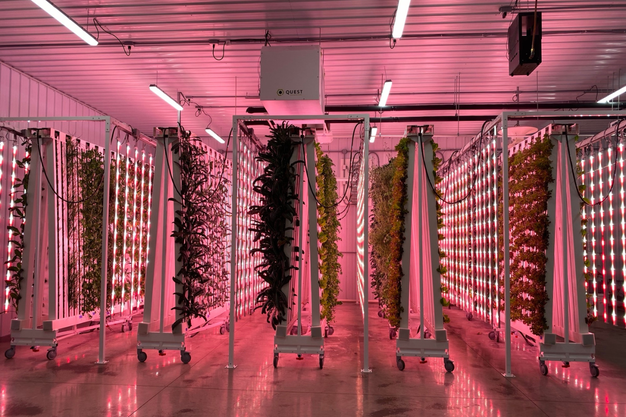
Farm Girl Greens grow room showing off ZipGrow mobile tower trellis under LED lighting
Market volatility and margin pressure
The farm planted the first seeds in November 2019. By March 2020, the restaurant and farmers market channels had either closed or switched to takeout. “Running a business in the early 2020s was a challenge for any small business owner,” says Lepak. “We were successful in the beginning because of the grocery store supply chain and consumers wanting to buy directly from farmers.”
Farm Girl Greens focused on weekly home deliveries through a distributor as well as its own logistics. As restaurants reopened, sales shifted to food service accounts, reducing margins compared to direct-to-consumer channels. “It was profitable but not so predictable,” says Lepa about the green phase.
An additional outlet was operated by a non-profit nonprofit that supplied food pantries at retail prices by paying subsidies rather than consumers. “The food was free to the consumer, but the funding was unpredictable and then dwindled.”
Utility costs added further pressure. Rising energy bills prompted the farm to build a grant-funded solar installation. The system remains in effect today. “New York state is seeing energy costs double from one month to the next right now,” Lepak says. “Not just for companies.” Profitable but subject to fluctuating demand, unstable funding streams and rising operating costs, the green model became more difficult to plan.
 © Green farm girls
A microenterprise license changes the model
Legalization introduced another option. Farm Girl Greens obtained a Micro Business License from the Office of Cannabis Management, New York’s governing body for adult cannabis. “The emerging market of adult-use cannabis cultivation has a bright future,” says Lepak. “The Bureau of Cannabis Management has taken steps to prevent large growers from flooding the market. Because we are a small grower and a predominantly female-owned business, we have been able to take advantage of training and fees at reduced prices and sometimes at no cost.”
The license allows cultivation, processing, distribution and retailing under one structure. For now, the farm is cultivating and shaking the flowers, using a third-party processor to extract them, and selling wholesale to pharmacies. As an indoor micro-business, the production covers 3,500 square feet of space and processes 1,700 pounds of cannabis per year.
Different crop, different system
Change required new infrastructure. The ZipGrow tower system used for leafy greens has been replaced with a high-pressure aeroponic recirculation system designed by Current Culture, along with a vertical rack from Pipp Horticulture.
“The leafy greens in our ZipGrow system didn’t require as much space and had a shorter seed-to-harvest cycle,” says Lepak. At peak production, the farm harvested the equivalent of 1,500 heads of lettuce per week while planting another 1,500 seeds.
Indoor cannabis works on a longer cycle, usually between 90 and 100 days. With a flower room currently in operation, the farm expects five harvests a year at full production. A second flower room is planned. Once built, a staggered planting schedule would allow ten harvests per year.
 © Green farm girls
Higher margins, higher limits
Per square foot, cannabis offers stronger margins than leafy greens, Lepak says. But regulatory costs and add-ons dampen this advantage. “We expect margins to increase as cannabis legalization and additional fees decrease. These fees are very close to being cost prohibitive.”
Compliance-related packaging requirements and limited access to banking continue to weigh on profitability. Job applications have also changed. Leafy greens required a steady weekly workforce to manage the cycles and distribution of perishable crops. Growing cannabis involves less daily handling, but requires more concentrated work during the harvest and processing periods.
 © Green farm girls
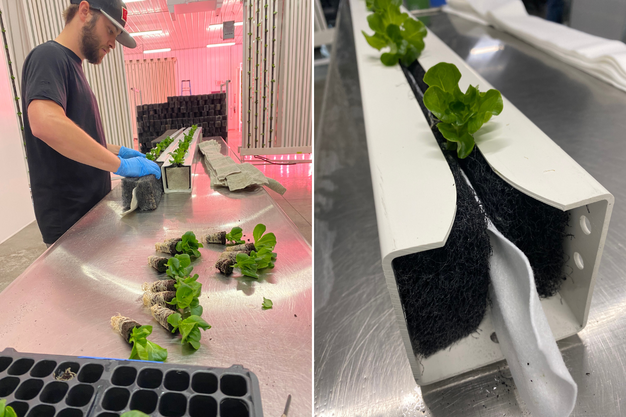
A member of the Farm Girl Greens team transplants seedlings (left) and inside a Matrix Media ZipGrow tower channel (right)
Looking back
Despite the transition, Lepa says he would still start with green leaves. “I enjoyed learning the process of indoor growing and selling at farmers markets,” she says. “Being a grower that delivers product directly to a consumer was a joy for me.”
Farm Girl Greens is selling its ZipGrow tower inventory as it consolidates its cannabis growing operations. “We have a total of 630 towers and associated lights and are willing to sell 450 towers, 180 towers or all 630 together,” says Lepak. “The eight-foot towers are mounted in 21 racks of 30 units. Complete system purchase of all 630 towers includes additional climate control equipment at no additional cost: CO2 generator and vertical V-Flow fans.”
Those interested in buying towers can go directly to Lepak (email protected).
A video tour of the Farm Girl Greens farm setup © Green farm girls
Complete design of the ZipGrow tower system inside the farm
For more information: 
Green Farm Girls
Abby Lepak, co-owner
(email protected)
www.instagram.com/farmgirlgreens
Cannabis News
Colorado Lawmakers Reject Bill That Would Have Put Marijuana And Alcohol Tax Hike On Ballot To Fund Mental Health Treatment

Colorado lawmakers have rejected a bill that would have put a measure on the state’s November ballot that would have asked voters. increase taxes on marijuana and alcohol to support mental health treatment.
Following the recommendation of the bicameral Capital Development Committee (CDC) last week, members of the House Health and Human Services Committee on Wednesday defeated the legislation in a 7-6 vote by Senators Bob Marshall (D) and Judy Amabile (D).
“We’ve made our criminal system the default mental health system for people over 18. It’s been a travesty,” Marshall said Wednesday before the panel’s vote to reject his bill. “It’s been a known plague for years and years and years, and yet nothing is happening to fix the problem.
“At the end of the day, this is something that has to be done,” the sponsor said of HB 1301, which would raise taxes on substances and raise additional revenue to create a mental health fund overseen by the state Department of Human Services (DHS). “And if we don’t do it now, the problem will only get worse.”
If it had advanced in the Legislature, voters across the state would have decided to raise the state’s retail marijuana sales and excise tax by 0.42 percentage points on the November ballot. Taxes on alcohol would also rise for the first time in more than 30 years, at varying levels depending on the type of product.
“The bill requires the treasurer to transfer to the hospital support account created in the capital building fund an amount equal to the tax revenue obtained as a result of the bill,” the summary summarizes. measure he said DHS would be able to spend the funds “in order of priority,” starting with establishing a mental health institute in Aurora, then going toward the institute’s operational costs and a “long-term civil commitment facility” in Mesa County.
Under the amendments passed in committee on Wednesday, the tax increase on alcohol would be reduced slightly, but not for cannabis. The bill’s title was also revised in response to input from the state attorney general, and a fiscal note was added to the $14,000 in programmatic costs, which the sponsor said would come out of the general fund.
At last week’s CDC meeting, Rep. Tammy Story (D), the panel’s vice chairwoman, asked Marshall’s House bill sponsor how the proposal to raise marijuana taxes reconciles the fact that the state has seen a decline in cannabis sales and resulting revenue in recent years. Marshall said he appreciated the concerns, but had no plans to decriminalize cannabis.
“In looking back maybe a the sales the tax maybe be be better,” Marshall admitted Wednesday. “But is in the year has the title now—‘the tax good harmful substances’—and we put marijuana in the year there in has the suggestion of a couple of has sheriffs, simply to share it has pain, so to talk.”
Marijuana industry representatives have it criticize The bill’s marijuana tax provision is partly because the state already imposes significant taxes on cannabis sales compared to other states and products. Making it more expensive for consumers to buy marijuana from licensed dealers could also hurt efforts to stamp out the illegal market by drawing buyers to unlicensed sources that won’t generate tax dollars for the state.
In the meantime the state is expected to exceed $1 billion in marijuana sales by 2025, a milestone the governor announced in December.—tax revenue from cannabis sales has steadily declined over the past five years as more states have implemented legalization and intoxicating hemp products have grown in popularity. However, cannabis brings in more tax dollars than alcohol or cigarettes.
Adult marijuana is currently taxed at three levels in Colorado: a 15 percent excise tax, a 15 percent excise tax, and a general state sales tax of 2.9 percent. As one of the first states to legalize recreational marijuana, Colorado’s revenue from such sales “grew steadily over the first eight years of legalization to $424.4 million by 2020-21,” according to a state report released last month.
—
It’s Marijuana Time tracking hundreds of cannabis, psychedelic and drug policy bills in state legislatures and Congress this year. Patreon supporters by pledging at least $25/month, you’ll get access to our interactive maps, charts, and audio calendars so you never miss a development.
Learn more about our marijuana bill tracking and become a Patreon supporter to gain access
—
Meanwhile, the Colorado House of Representatives sent a bill to the governor last week allow terminally ill patients to use medical marijuana in healthcare facilities such as hospitals. Advocates have been critical of the changes made throughout the legislative process; for example, arguing that hospitals would be right to do so. option– than mandate—The use of medical cannabis in their facilities fundamentally undermines the intention of the reform.
Gov. Jared Polis (D) also said last month his state did not have to join a lawsuit supporting a federal ban on the possession of guns by people who use marijuana that recently went before the US Supreme Court, and he personally opposes the state attorney general’s “legal position on this.”
user photo Brian Shamblen.
Marijuana Moment is made possible with the help of readers. If you rely on our pro-cannabis journalism to stay informed, consider a monthly Patreon pledge.

Tilray Brands has signed an asset purchase agreement to acquire some of BrewDog’s strategic assets in the United States, including a brewery, pub and hotel in Columbus, Ohio, as well as New Albany, Ohio, Cleveland, Ohio and Las Vegas, Nevada. As one of Ohio’s largest craft beer brands, this acquisition aligns with Tilray’s regional jewelry strategy.
Irwin D. Simon, President and CEO of Tilray Brands, said: “The acquisition of BrewDog’s key US assets strengthens our US beverage platform and advances our regional craft beer strategy in North America. BrewDog has built a strong following and established a highly visible presence in Las Vegas, including a Las Vegas flagship pub model, creating destination spaces that deepen consumer engagement, offering new opportunities to introduce and sell a broader portfolio of Tilray beverage brands.” meanwhile”.
Mr. Simon continued: “This transaction reinforces Tilray’s acquisition of BrewDog’s operational assets, building on previously announced deals in the UK, Ireland and Australia. Tilray now owns the BrewDog brand and its intellectual property worldwide. This positions us to lead the next chapter of the brand with a highly integrated North American footprint and a long-term publishing strategy designed for joint growth and brand strength.”
Under the asset purchase agreement, Tilray will acquire BrewDog’s US manufacturing and brewing operation in Columbus, Ohio, three Ohio pubs (Columbus, New Albany and Cleveland), a hotel in Columbus, Ohio, and a BrewDog franchise location in Las Vegas, Nevada, and a licensed BrewDog airport location in Denver, Colorado. The transaction is expected to close in the first quarter of 2026, pending customary regulatory approvals.
For more information:
Tilray
www.tilray.com

Dutchies Hash Wednesday at the Cannabar!

Election Eve LIVE | Cannabis and Politics in 2024? | 8PM EST

Erick Khan’s Mold Claims Just Took A WILD Turn!

WE HAVE TO GET OUR FRIENDS OUT! | BLUNTZ

Marijuana Retail Report

Vireo Growth Is Now the 7th Largest MSO by Revenue – New Cannabis Ventures

When we decided to start our own hydroponic farm, we were always open to the possibility of growing cannabis down the road

Colorado Lawmakers Reject Bill That Would Have Put Marijuana And Alcohol Tax Hike On Ballot To Fund Mental Health Treatment

Ohio Hemp and Cannabis Changes Take Effect This Week

Ice Cream Cake Pearl Pipe Session

“Our system can manage equipment across 10,000+ m² using just a few wires”

Florida Workshop to Discuss What Constitutes a ‘Cartoon’ in Hemp Packaging

Mazar-i-Sharif Hash Wednesday

Re-release of the full show of Cannabis Coast to Coast news. Republican Texas DA Fires Up vs. laws;

From Finance to Wellness: Brad Zerman’s Impactful Pivot

Your Cannabis Business: Consistent Filings Are Critical

DEA’s Cole Reverses His “priorities” ; Prohibitionists Dig In; Dead & Co Celebrates 60 years in SF

Weak Michigan Cannabis Sales Again in July – New Cannabis Ventures

New Hampshire Governor Says Federal Marijuana Rescheduling Won’t Change Her Opposition To Legalization

Texas DA Partakes on Tik Tok to prove a point; Boston Sheriff arrested for Extortion of $ w/ Ascend
-
 Cannabis News7 months ago
“Our system can manage equipment across 10,000+ m² using just a few wires”
-
 Florida7 months ago
Florida Workshop to Discuss What Constitutes a ‘Cartoon’ in Hemp Packaging
-
 Video6 months ago
Mazar-i-Sharif Hash Wednesday
-
 Video7 months ago
Re-release of the full show of Cannabis Coast to Coast news. Republican Texas DA Fires Up vs. laws;
-
 Video7 months ago
From Finance to Wellness: Brad Zerman’s Impactful Pivot
-
 Best Practices7 months ago
Your Cannabis Business: Consistent Filings Are Critical
-
 Video7 months ago
DEA’s Cole Reverses His “priorities” ; Prohibitionists Dig In; Dead & Co Celebrates 60 years in SF
-
 aawh7 months ago
Weak Michigan Cannabis Sales Again in July – New Cannabis Ventures